In the mixture of people that self-identify as libertarian, anarcho-capitalist, voluntaryist, or agorist, voting is a hotly debated activity. There are the more subjective shame-based arguments that point out the disgustingness of playing the states game in begging for a little less tyranny, as a slave might beg their master for fewer whippings. There are also the rational and ethical arguments such as Lysander Spooner’s work in No Treason: The Constitution of No Authority, which describes a vote as a “bullet” fired in self-defense against the other vote-bullets aimed at us with the intent to coerce and control, at the cost of our lives if resisted hard enough.
I self-identify using all of the above labels, while at the same time, have run a campaign in the Texas state gubernatorial election, and intend to continue doing so as my professional obligations allow.1 This places me directly in the center of this controversy, and has required much effort and contemplation in determining the correct moral position on the topic. This article will make a new argument in the space based on the libertarian non-aggression principle as a fundamental rubric for acting in a moral way; that is to say without initiating harm or coercion on any peaceful people. I will integrate the strongest arguments from Spooner and iterate on the inaccuracies found in most debates.
Premise 1: People that assist in criminal activity are partially or equally culpable for the results of the groups actions.2
(IE: John disables a banks’ security systems for a group of bank robbers, or serves as the getaway driver. John is at least partially culpable for the theft crime and bank robbery as a co-conspirator that provided material support to the groups efforts.)
Premise 2: Voting for a candidate has the effect of assisting them in winning office and gaining potentially coercive power over innocents and / or access to resources for harm and coercion.
(Voting provides material support to the effort of political crime)
Conclusion: If the supported candidate is subsequently elected, and those powers and resources are used to create innocent victims and to coerce, the person that voted for the candidate is at least partially culpable for these crimes as a co-conspirator.
Let’s begin with the great philosopher activist Lysander Spooner and his famous vote-bullet argument in favor of self-defensive voting.
Quote
“In truth, in the case of individuals, their actual voting is not to be taken as proof of consent, even for the time being. On the contrary, it is to be considered that, without his consent having ever been asked, a man finds himself environed by a government that he cannot resist; a government that forces him to pay money, render service, and forego the exercise of many of his natural rights, under peril of weighty punishments.
He sees, too, that other men practise this tyranny over him by the use of the ballot. He sees further that, if he will but use the ballot himself, he has some chance of relieving himself from this tyranny of others, by subjecting them to his own. In short, he finds himself, without his consent, so situated that, if he use the ballot, he may become a master; if he does not use it, he must become a slave. And he has no other alternative than these two. In self-defence, he attempts the former.
His case is analogous to that of a man who has been forced into battle, where he must either kill others, or be killed himself. Because, to save his own life in battle, a man attempts to take the lives of his opponents, it is not to be inferred that the battle is one of his own choosing. Neither in contests with the ballot – which is a mere substitute for a bullet – because, as his only chance of self-preservation, a man uses a ballot, is it to be inferred that the contest is one into which he voluntarily entered; that he voluntarily set up all his own natural rights, as a stake against those of others, to be lost or won by the mere power of numbers.
On the contrary, it is to be considered that, in an exigency, into which he had been forced by others, and in which no other means of self-defence offered, he, as a matter of necessity, used the only one that was left to him.” 3
A better analogy than Lysander Spooners “vote bullets”.
Spooner is very right that someone voting is not an affirmation of consent to be controlled by government. Spooner is very right that people use government guns to force their ideas and way of life onto us. Spooner is very right that there is nothing wrong with attempting to fire the exact same government guns back at the people trying to fire them at you. However, the lever that is missing, and that invalidates the claim of self-defense in Spooner’s vote-bullets analogy, is that there is no “ballot-trigger” we can pull that will launch defensive vote-bullets only at those firing offensive vote-bullets at us, our vote-attackers.
A more apt analogy to Spooner’s vote-bullets would be vote-grenades. You toss them into a room, and they explode, maiming indiscriminately, vote-attackers and innocent bystanders alike. The collateral damage can be so far-reaching that its almost impossible to quantify.
You cannot call an action self-defensive if it creates new innocent peaceful victims.
The grenades aren’t even limited to rooms with people from the same vote-war theater! People vote-grenaded for the anti-war candidate Obama, helping a man attain power that was used in the murder of between a few hundred, and a few thousand non-combatants and children.4 Those victims weren’t even allowed to send vote-grenades back at their attackers. Vote-grenades are totally indiscriminate, with globe spanning carnage.
Other people vote-grenaded for Trump to keep Hillary Clinton and her leftist socialistic policies away, helping a man attain government power which he then used in all manner of coercions and murder. From forcing the owners and employees of General Motors to produce more ventilators5 for the COVID pandemic (ventilators we now know ended up stacking additional bodies), to more mass military-slaughter on the order of thousands of innocent lives.6
Not only are voters not getting the government guns pointed in the direction they want, as politicians eternally flout their constituent-commitments and campaign promises, but in the attempt they are entangling and involving themselves in human collateral damage the world over.
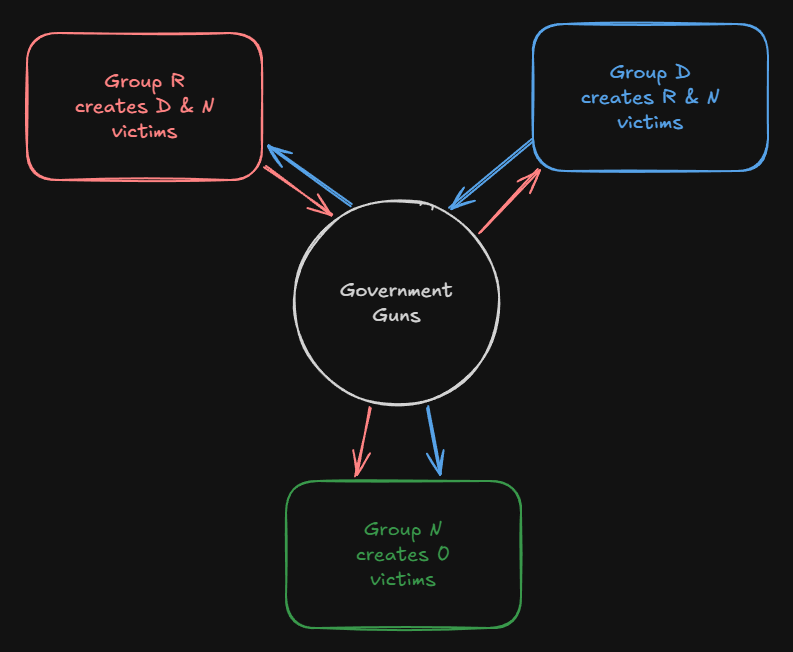
Consider the following reasoning. There is a group of men with guns G (government) and three groups of slaves R, D, and N (republican voters, democrat voters, and non-voters). You get to chose one of the three slave groups to be in.
Group R points G’s guns at D and N to get what they want. Group D points G’s guns at R and N to get what they want. Group N doesn’t point G’s guns at anyone. (this is the group not considered in Spooners argument)
The question is, which group is peaceful, and which are aggressors? Which group is the moral one to stand in? We can easily grant that G is ubiquitously evil, of course, and is the driving force behind this entire problem. As for the slave groups competing over the coercion, there is one that is unique in that they are not creating new victims of people not already attempting to coerce them; group N.
Groups R and D are caught in a mutual offense / self-defense scenario. A scenario which shouldn’t even be possible except through the intergenerational coercion facilitated by G, making it possible for both groups to be subjected to coercion from the other since birth. We can’t point to a member of one or the other and determine who “initiated” the aggression; they are both actively participating in it, while also trying to claim self-defense from the very real aggressions of the other.
Neither R nor D can complain about the others pointing guns at them because such a defense would be precluded by their own hypocritical commissions of the exact same aggressions (same in form if not execution and effect as well). The contradiction in complaining that one’s victim is committing the exact same crime they are presently inflicting upon them is obvious and apparent.
Group N, however, has every right to complain about R, and D! In the process of their war for control of power, or even in their contradictory attempts at self-defense, these groups are pointing G’s guns at N as well, creating new innocent victims out of people that are not, nor have ever threatened or coerced them! In their attempts to defend themselves from each other they are helping G create more coercion, human carnage, and destroyed property.
The N’s might really like to defend themselves from the R’s and the D’s, but there is no lever in democratic systems to pull that will fire vote-bullets restricted to only maiming other vote-attackers attempting to coerce them. The only available options most democratic systems and votes offer is joining with the R’s or the D’s in their actions that harm everyone including other N’s.
Democracy is basically a bunch of people in the same room trying to set off bombs in ways that will somehow only hurt the other people in the room arming bombs against them. Everyone dies and the building falls on the neighbors kids.
Some might be screaming about the L’s at this point, wondering where they are in the analogy. Well first – they’re not in the analogy because they aren’t currently winning any power anywhere, so it would have just convoluted the analogy.
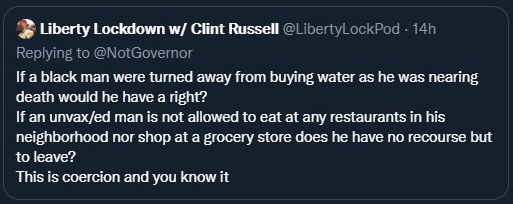
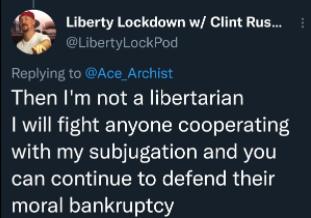
Second, most “Libertarians” running for office have barely a passing acquaintance with the principles behind the label. If most of them ever actually won power (something mostly contradictory to libertarianism on its face) they would be creating victims out of the N’s no less (ok maybe a little less 🤣) than the R’s and D’s. See prominent libertarians calling for business owners to be forced at government gunpoint to accept unvaccinated customers onto their property during COVID7, or the newer in vogue attempt by right-entryist subversives to craft a closed state border argument with a straight libertarian-face8, for evidence of that.
Most libertarian pahtay candidates support at least some elements of aggression, spanning the entire spectrum of political coercion; including such absurdities as the existence of a non-consensually funded military, the reduction and even abolition of private property rights, state border enforcement, tariffs, even some forms of direct taxation as my opponent Mark Tippetts did in the 2018 Texas gubernatorial race (where he won the nomination), and even socialized health care like my opponent Kathy Glass touted in that same race! Most L options have their supporters still assisting in aggressions.
“People that assist in criminal activity are partially or equally culpable for the results of the groups actions.”
I suppose you could wish to live in a society where the dispute resolution contracts functioned such that people were only culpable for their specific actions. The getaway driver would only be guilty of speeding as he helped his team escape from the bank, not for the stolen money in his partners bag in the trunk, or the people the “heavies” on his team murdered in the process of executing their crime. This leads to some absurd situations and conclusions, which is likely why common law justice systems throughout history have held co-conspirators culpable for the crimes their group commits.2 I’ve never had a person contest this premise though so I won’t spend addition time on it here.
“Voting for a candidate has the effect of assisting them in winning office and gaining potentially coercive power over innocents and / or access to resources for harm and coercion.”
I have had many people tell me that voting is ineffectual, that it does nothing, or that the winning candidates are decided by other people, or processes, nefarious or otherwise, that are not influenced by one’s vote. If this claim turns out to be true then the argument is in fact defeated. Voting would then be as morally important as one’s preferred Metallica album. One could vote all they wanted and still be culpable for none of their candidates actions. Though it seems nonsensical for one who was convinced that voting did precisely nothing to spend their time trying to vote, this argument would likely lack cogency for them.
There is another rejoinder to this argument, of which I am fond, because it begins with a position we libertarians agree with; that merely telling someone to do some crime does not make one a coconspirator in it, if and when enacted. This is another truth on the pile of difficult positions we libertarians are vexed with defending. We all have agency and control over our actions. Encountering some suggestion that we do something does not turn us into a mindless automaton enslaved to carry it out.
This eliminates silly notions like “stochastic terrorism” that are common bugaboo’s in modern discourse. Or the farce that is “fighting words”, where some courts hold that you can remotely control people’s brains into initiating combat by vibrating the air with your mouth in certain ways. The legal concept of incitement, outlawed in many jurisdictions, is another example of this mystical voice-activated-brain-control nonsense. Those articles are for another time, however.
Next, they build on this adept libertarian position by claiming that voting is equivalent to this simple expression of desire for them to take some action, and, as with incitement or other mouth-air-vibrations, does not remote control the government into giving anyone power, and thus does not leave one culpable for their crimes. I must admit, this is a solid rebuttal; almost convincing.
Unfortunately, there is a break in the attempted analogizing of words and votes. There is a stark agentic difference between how the two function. First, as we just discussed, if you think the voting system is a big farce decoupled from the cast votes, who’s result is actually controlled by shadowy cabals, then this argument doesn’t apply.
For those that think votes are counted to some degree of accuracy, and that the winner is determined by them (filtered through the electoral college clown show of course), you must also acknowledge the lack of agency the voting system has to violate the voting results, in comparison to a person hearing a suggestion from another to commit a crime; that is, very little for voting, and almost complete for the person.
You can evince this yourself directly. Tell the next 100 people you meet to kill you. I have no problem suggesting this to you, as I will not be culpable for your dumb decision to follow instructions. 😉 Next, now that you’ve survived those 1:100,000 odds9, compare the success rate of your requests to the success rate of the vote-count-matching candidate wins (filtered through the electoral college clown show of course). The disanalogy is thus laid bare with it’s missing agency revealed.
“If the supported candidate is subsequently elected, and those powers and resources are used to create innocent victims and to coerce, the person that voted for the candidate is at least partially culpable for these crimes as a co-conspirator.”
There are two objections or exceptions that can provide for a vote that does not run afoul of this syllogism and one that fails.
The supported (voted for) candidate does not win.
If they don’t win then there are no innocent victims, coercion, or other crimes for the voter to be a co-conspirator in. This means that most votes for libertarians, even the least-consistent and unprincipled ones, don’t end up being immoral or criminal. Or do they? Are failed bank robbers let free or are they charged with “attempted bank robbery”?
Is pointing the vote bullet gun at someone, but not firing it, or firing it and missing, still the crime of “threatening deadly force”? It would seem to be obvious that this is not the exception that some people wish it was. It is still wrong to threaten your neighbors with your vote bullets, even if they don’t end up hitting their targets.
The vote is not for a candidate, but for a referendum, or ballot measure that creates no victims.
Not having to trust that a candidate one assists in gaining power will do what just about every single politician in history has done (breaking promises and doing things their voters didn’t want) makes for a simpler discussion for sure.
A referendum to abolish the IRS, or reduce taxes, or eliminate some regulation, for example, would create zero new innocent victims, and is therefore a fine exception to this argument. You would be able to fire your vote-bullets specifically at the people that supported those things being done to you, without subjecting innocent third parties to any coercion. Carry on!
The supported candidate wins and creates no victims.
This is a high bar to reach, but is theoretically possible. One could run on a platform of NAP (non-aggression principle) compliance, never use power to coerce, never use government resources to harm, vote no on every bill that contained coercion, end every government program and agency they had the capacity to end, and never even so much as cash a paycheck filled with extorted tax money.
I attempted this with my campaign for Not Governor of Texas to see if it was even possible. While this position was clearly way too libertarian to actually get the nomination of the “libertarians” in the pahtay, I did prove it to be possible, at least in Texas, and at least up till the point of nomination. I am less confident that this would be doable at a presidential level, but I see no immediate contradictions with the notion.
It appears that it is neither true that voting is always immoral, nor that it is always morally permissible. It depends on what you are actually achieving with your decision to take action in support of a particular person or cause.
If you are assisting in the control and coercion of peaceful people that are not threatening you, then you are culpable for providing that assistance, even if you had the good self-defensive intentions of protecting your own property or freedom.
If you are supporting political processes that are strictly constrained to reducing or eliminating government coercion, then there ceases to be a moral objection. This is not to say that these political processes are valid in the first place. If a thief robbing you in a dark alley gives you a button that he says will cause him to stop robbing you, while some may say that it’s dumb or gross to play his games, there’s nothing wrong with pushing his button in an attempt to defend yourself.
Campaign Context My campaign is run with a specific focus on using the immoral game of thrones that is politics, and the attention people give it, to bring a principled message of liberty to the masses. The website is NotGovernor.com. The primary message is one of realizing the importance and power of withdrawing ones consent to be governed, and provides an example method of doing so using a Declaration of Individual Independence. ↩︎
Inchoate Crimes and Conspiracy https://criminallaw.uslegal.com/incohate-crimes/conspiracy/
Citing a US legal source is not intended as an appeal to US law as a valid authority, but as one example among many to be found in almost all legal systems linking the culpability for crimes across all participating conspirators. ↩︎↩︎
Obama Government Murder With such a biased press as exists today accurate information is difficult to obtain. The governments own reporting admits to over 500 drone bombings with several hundred innocent non-combatants and child murders. Some NGO’s report a few thousand.
Trump Government Murder Here’s some that they’ll admit to:
Annual Reports on Civilian Casualties in Connection With United States Military Operations 2018 Report (924 murders with many more injured) 2020 Report (~100 murders with many more injured)
Trump also signed an executive order in 2018 that revokes an Obama policy requiring US intelligence officials to report civilian deaths in drone strikes outside of active war zones… Which will make getting data like this more difficult and unreliable going forward.
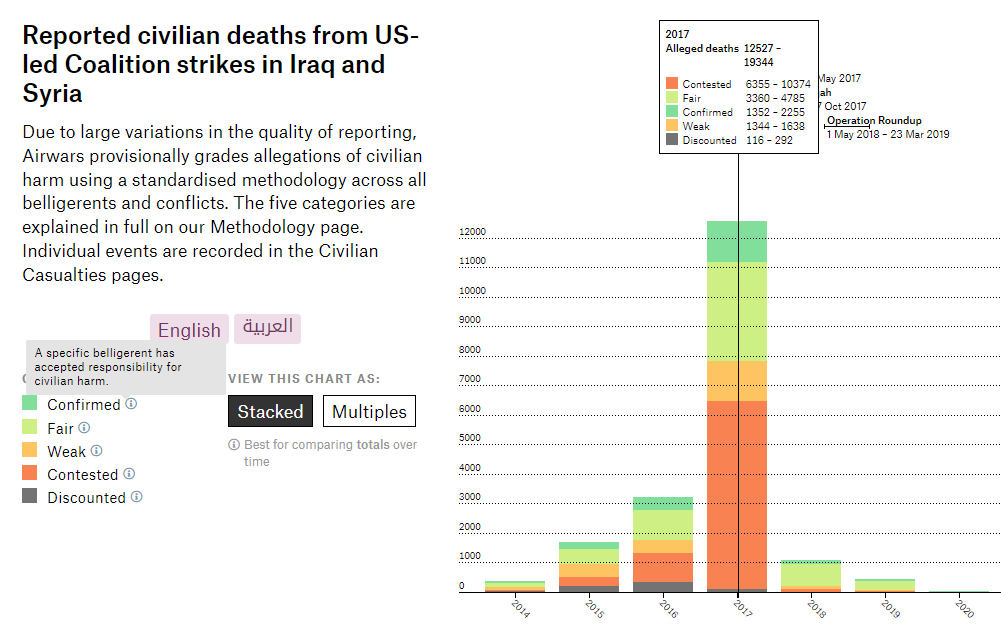
To bracket what they’ll admit to with an outside observer possibly biased in the other direction – Airwars reports 2255 confirmed murders in 2017 alone. Report↩︎
Forced Association at Government Gunpoint Libertarians Clint Russell Twitter.com, September 2021 Tweets have since been deleted. ↩︎