
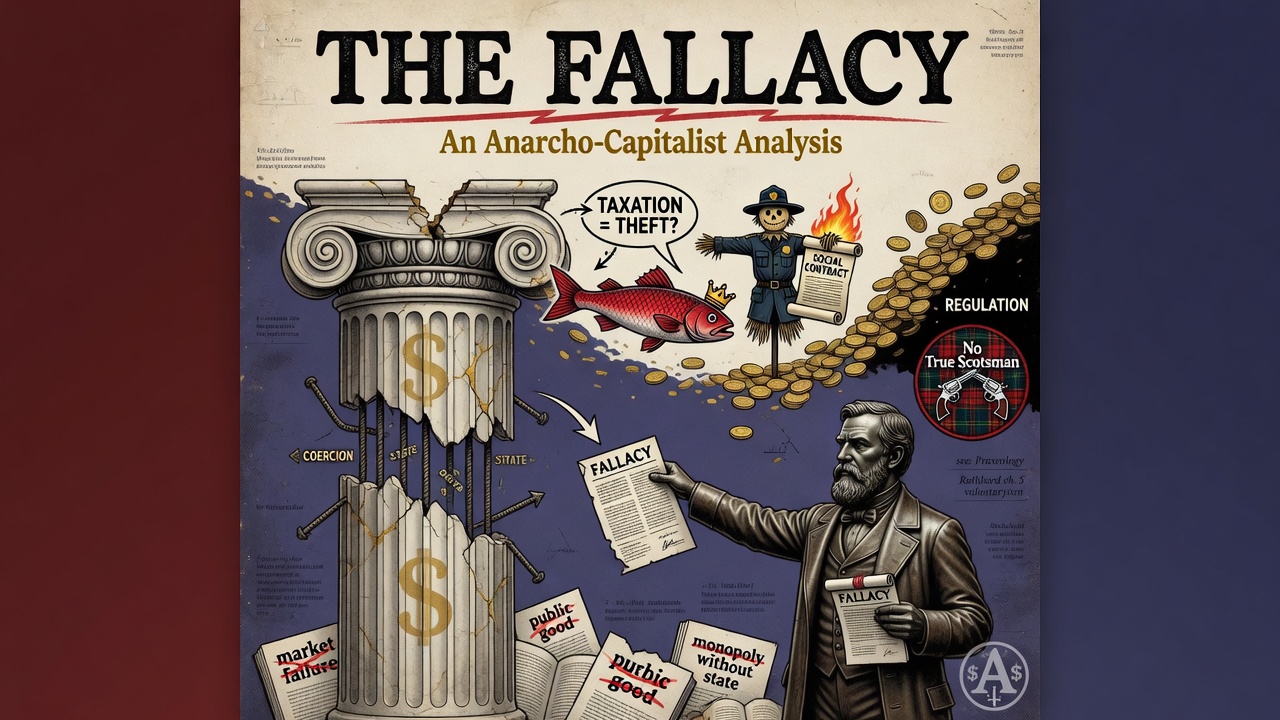
Fallacy (from Latin fallacia, meaning “deception” or “trick”) is an error in reasoning that undermines the validity or strength of an argument while often appearing persuasive or sound. In logic and critical thinking, a fallacy is typically an argument that seems better than it actually is—either because it violates deductive validity, inductive strength, relevance, sufficiency of evidence, or rules of rational dialogue.
The rigorous identification and avoidance of fallacies is not merely an academic exercise but a vital tool for liberty. Many defenses of the state, taxation, and coercive monopolies rely on deceptive reasoning that smuggles in unexamined norms or ignores the logical implications of voluntary interaction, private property, and the non-aggression principle (NAP). Thinkers in the Austrian and AnCap traditions—building on praxeology (the logical science of human action) and argumentation ethics—insist that sound reasoning exposes the contradictions in statism and supports a society of purely voluntary exchange, private defense, and free markets.
Etymology and Core Definition#
The term “fallacy” entered English in the 16th century via Latin and French, originally denoting deceit or a trick. In philosophy, it evolved to mean a specious argument or false belief. Modern definitions emphasize:
- An argument that appears valid or cogent but fails upon examination (e.g., deductively invalid or inductively weak).
- A reasoning error that may stem from ambiguity, irrelevant premises, unjustified assumptions, or suppressed evidence.
- Not every mistake or false belief qualifies; the error must typically involve an argument or inference that misleads.
Fallacies often serve to rationalize aggression (the initiation of force or fraud). Recognizing them protects the integrity of arguments for self-ownership, homesteading, and contractual society.
History: From Aristotle to Modern Informal Logic#
The systematic study of fallacies began with the ancient Greek philosopher Aristotle (384–322 BCE). Born in Stagira (northern Greece) to a family of physicians, Aristotle studied at Plato’s Academy in Athens for nearly 20 years, later tutored the young Alexander the Great, and founded the Lyceum school in Athens. He authored works across logic, biology, ethics, politics, and metaphysics, profoundly shaping Western thought.
In his treatise Sophistical Refutations (part of the Organon, his collected logical works), Aristotle provided the first systematic classification of fallacies—identifying roughly 13 types—to counter the sophists, who used deceptive verbal tricks to win debates rather than pursue truth. He distinguished language-dependent fallacies (e.g., equivocation) from those independent of language (e.g., begging the question or accident). Aristotle viewed logic as the “tool” (organon) for sound reasoning, essential for dialectic, science, and ethics.
Medieval scholars (e.g., in the Port-Royal Logic) and later thinkers like John Locke (who popularized ad fallacies such as ad hominem and ad verecundiam), Jeremy Bentham (Handbook of Political Fallacies, 1824), and John Stuart Mill refined the study. The 20th century saw a revival in Informal Logic, emphasizing everyday reasoning over formal syllogisms. Key modern contributors include Ralph H. Johnson and J. Anthony Blair (Logical Self-Defense), and Douglas Walton (pragma-dialectical and scheme-based approaches).
Anarcho-capitalist thinkers extend this tradition by applying logical rigor to political economy. Murray Rothbard (1926–1995) and Hans-Hermann Hoppe (b. 1949) demonstrate how praxeological deduction and performative consistency reveal fallacies in statist arguments.
Types of Fallacies#
Fallacies are broadly divided into formal (structural flaws in deductive logic, e.g., affirming the consequent: “If P then Q; Q; therefore P”) and informal (content- or context-dependent errors). Informal fallacies are often grouped as:
- Relevance fallacies (irrelevant premises): Ad hominem, straw man, red herring, appeal to pity/emotion.
- Presumption fallacies (unwarranted assumptions): Begging the question, false dilemma, slippery slope (when probabilities are ignored), complex question.
- Ambiguity fallacies: Equivocation, amphiboly, accent.
Some Anarcho-capitalism-relevant examples:
- Straw man: Misrepresenting AnCap as “lawless chaos where anyone can murder” instead of a system enforcing the NAP through private courts, insurance, and reputation.
- Appeal to authority (ad verecundiam): “Economists and governments agree public goods like security require state provision.” (Ignores that “experts” often have incentives tied to state power.)
- False dilemma: “Without the state, there would be warlords or nothing.” (Overlooks historical and theoretical private provision of defense and law.)
- Begging the question: Assuming from the outset that markets “fail” at public goods without proving the normative claim that aggression is justified to correct it.
- Ad populum: “Most people support democracy/welfare, so it must be legitimate.” (Majority preference does not override individual rights or logical consistency.)
Other frequent errors in liberty debates include hasty generalization (from isolated market imperfections to “markets always fail”), post hoc ergo propter hoc (attributing prosperity solely to government), and suppressed evidence (ignoring private lighthouses, roads, or security firms in history).
Key Figures#
Aristotle remains the foundational figure. His Sophistical Refutations and broader Organon established logic as a discipline. While his Politics defended aspects of the polis, his methodological commitment to non-contradictory reasoning provides timeless tools for critiquing coercion.
Hans-Hermann Hoppe (b. 1949, Germany) is a leading contemporary anarcho-capitalist philosopher and economist. Educated in Germany and influenced by Mises and Rothbard, he is professor emeritus at the University of Nevada, Las Vegas, and founder of the Property and Freedom Society. His works apply rigorous logic and ethics to critique democracy, socialism, and the state while advocating private property anarchism.
Prominent works: A Theory of Socialism and Capitalism (1989, includes the public goods paper), Democracy: The God That Failed (2001), The Economics and Ethics of Private Property, and numerous essays on argumentation ethics and monetary theory.
Murray N. Rothbard (1926–1995) systematized anarcho-capitalism in works such as Man, Economy, and State (1962), For a New Liberty (1973), and The Ethics of Liberty (1982). He stressed the logical structure of economic science and natural law ethics, providing the deductive framework Hoppe and others built upon.
Conclusion and Importance for Liberty#
Mastering fallacies equips advocates of liberty to dismantle flawed justifications for the state while constructing robust alternatives grounded in reason, evidence, and ethics. In an era of complex policy debates, anarcho-capitalist analysis reminds us that many apparent “market failures” or necessities for government dissolve under scrutiny—revealing instead failures of logic, incentives, and respect for individual rights.
For further reading, consult Aristotle’s Sophistical Refutations, Hoppe’s Journal of Libertarian Studies article, Rothbard’s For a New Liberty, and resources like the Internet Encyclopedia of Philosophy’s entry on fallacies or yourlogicalfallacyis.com for visual guides.
This framework—rooted in truth-seeking logic—advances the anarcho-capitalist vision of a free society where persuasion, not force, governs human interaction.