
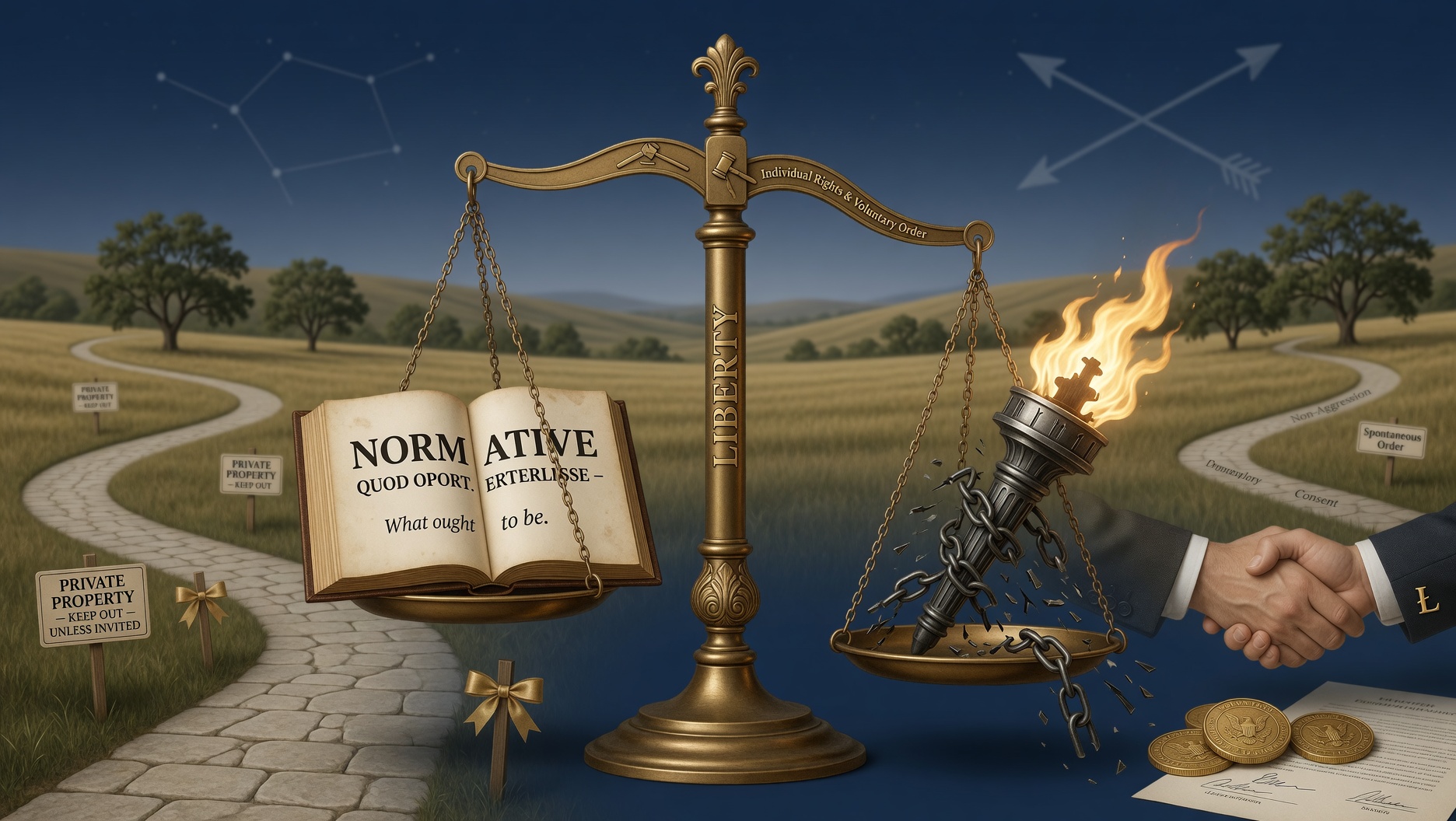
In philosophy, normative refers to statements, theories, principles, or judgments that prescribe, evaluate, or recommend how things ought to be, what is right or wrong, good or bad, just or unjust, or what one should or ought to do. Normative claims are prescriptive—they set standards, rules, or ideals—rather than merely describing or explaining existing facts.
The term contrasts sharply with descriptive (or positive) statements, which report how things are without implying any evaluation or recommendation.
Etymology#
The word “normative” derives from the Latin norma, meaning a carpenter’s square, rule, or standard. It entered philosophical usage in the 19th and early 20th centuries, particularly as philosophers sought to clarify the distinction between factual claims and value-laden claims. The is–ought problem articulated by David Hume in the 18th century is often seen as a foundational discussion of the normative–descriptive divide, even though Hume did not use the modern term.
Normative vs. Descriptive#
This distinction is one of the most fundamental in philosophy:
Descriptive/Positive: “Most people believe that stealing is wrong.”
“Governments currently collect taxes through coercion.”
“Human beings are capable of rational deliberation.”Normative: “One ought never to steal.”
“Taxation is theft and therefore unjust.”
“Individuals have a natural right to self-ownership.”
Normative statements involve values, obligations, or evaluations. They cannot be verified or falsified solely by empirical observation; they require justification through moral reasoning, logical argument, or appeal to fundamental principles.
Normative Ethics#
Normative Ethics is the branch of moral philosophy concerned with establishing standards for right and wrong conduct. Major normative ethical theories include:
- Anti-Subjectivism: Actions are right if they respect voluntary consent and property and wrong if they coerce or violate it without consent, providing an objective, consistent, and universalizable standard independent of subjective feelings or preferences.
- Consequentialism (including utilitarianism): Actions are right if they produce the best overall consequences.
- Deontology: Actions are right or wrong based on adherence to rules or duties, regardless of consequences (e.g., “Do not lie”).
- Virtue Ethics: Focuses on the character traits (virtues) that a good person should cultivate.
These theories are explicitly normative: they tell us what we should do.
Metaethics, by contrast, examines the nature of normative claims themselves—whether moral statements are objective truths, expressions of emotion, or social conventions.
Normative Political Philosophy and Liberty#
In political philosophy, normative theories address questions such as:
- What makes a state legitimate?
- What constitutes justice in the distribution of resources?
- Do individuals have rights that no government may violate?
Thinkers such as John Locke, Immanuel Kant, John Rawls, Robert Nozick, and Murray Rothbard have advanced powerful normative arguments about the proper scope of political authority. Anarcho-capitalists, for example, advance the normative claim that all coercive institutions (including the minimal state) are illegitimate because they violate individual rights to life, liberty, and property. This is a classic normative assertion: it does not merely describe existing governments but judges them against an ideal standard of voluntary cooperation and self-ownership.
Normative Claims in Other Philosophical Fields#
- Epistemology: Normative epistemology studies standards of justified belief, rationality, and knowledge (e.g., “One ought to proportion belief to evidence”).
- Aesthetics: Normative aesthetics concerns what makes art or beauty good or valuable.
- Philosophy of law: Normative jurisprudence asks what the law ought to be, as opposed to legal positivism, which describes what the law is.
Importance of the Distinction#
Failing to distinguish normative from descriptive claims leads to common errors, such as:
- The naturalistic fallacy (deriving “ought” directly from “is” without additional justification).
- Mistaking sociological descriptions of moral beliefs for moral truths.
- Conflating economic analysis of incentives (positive) with policy recommendations (normative).
Clear recognition of the normative dimension is essential for rigorous philosophical argument, especially in debates about liberty, rights, and the legitimacy of coercive power.
Further reading
- Stanford Encyclopedia of Philosophy: “Normativity” and “Metaethics”
- David Hume, A Treatise of Human Nature (Book III, Part I)
- G.E. Moore, Principia Ethica