
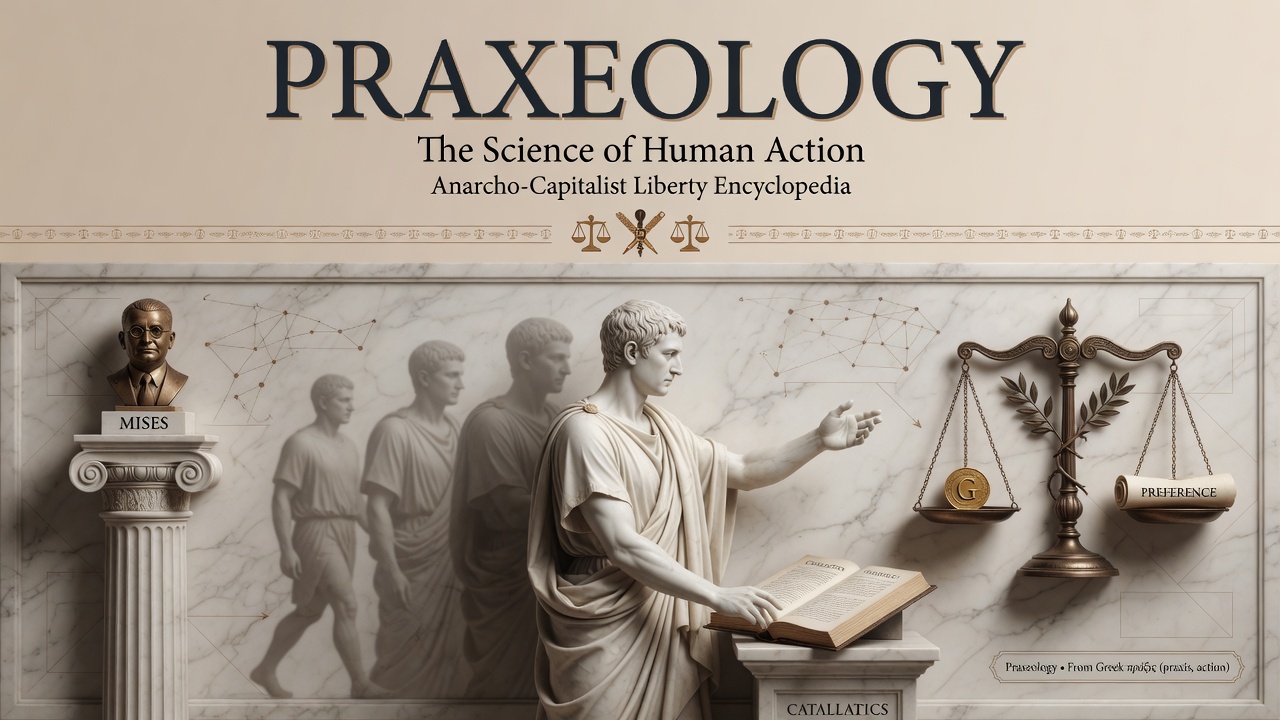
Praxeology (from Greek praxis, meaning “action”) is the deductive science of human action—the study of purposeful, goal-directed behavior. It forms the epistemological and methodological foundation of the Austrian School of economics and serves as the rigorous intellectual bedrock for anarcho-capitalist theory. In the anarcho-capitalist framework, praxeology attempts to demonstrate with logical certainty that a society based entirely on voluntary exchange, private property, and the absence of coercive state institutions is not only possible but optimal for human flourishing.
Unlike mainstream economics, which relies on empirical testing, statistical aggregates, and mathematical modeling, praxeology derives universal, aprioristic truths from the self-evident axiom that human beings act: they consciously choose scarce means to achieve preferred ends. This approach yields certain knowledge about economics, ethics, and social organization—knowledge immune to the uncertainties of historical data or laboratory experiments. Anarcho-capitalists, following Murray Rothbard, use praxeology to prove that the state is not a neutral arbiter but a violent intervener that systematically distorts the natural order of human action, producing poverty, conflict, and inefficiency.
Definition and Core Principles#
Praxeology begins with the fundamental axiom of action: “Man acts.” Action is purposeful behavior aimed at removing felt uneasiness by employing means to attain ends. From this single, incontestable truth—known a priori through introspection and logic—praxeologists deduce an entire body of economic and social theorems.
Key categories derived from the action axiom include:
- Ends and means: Every actor ranks ends according to subjective value and allocates scarce means accordingly (law of marginal utility).
- Time preference: Actors prefer present goods to future goods, explaining interest rates and capital formation.
- Exchange and catallactics: Voluntary interpersonal exchange benefits all parties (the foundation of market catallactics).
- Methodological individualism: Only individuals act; collectives (states, classes, societies) are abstractions that cannot act independently.
- Uncertainty and entrepreneurship: Human action occurs under uncertainty; entrepreneurs bear risk and discover opportunities.
Because these conclusions follow deductively from the nature of action itself, they are universal and immutable—true for all humans at all times and places. Praxeology thus provides certain knowledge where positivist methods offer only probabilistic correlations.
Historical Development#
The term “praxeology” was first used in its modern sense by French thinker Alfred Espinas in 1890, but it was Ludwig von Mises who systematized it as the foundation of economics in his 1949 masterpiece Human Action. Mises built on the subjective theory of value pioneered by Carl Menger (founder of the Austrian School) and the methodological individualism of Max Weber.
Murray Rothbard, Mises’s most brilliant student and the chief architect of modern anarcho-capitalism, extended praxeology dramatically. In his 1951 essay and later in Man, Economy, and State (1962), Rothbard subdivided praxeology into:
- Crusoe economics (isolated individual action)
- Catallactics (voluntary exchange)
- The economics of violent intervention (including the state)
- The economics of the marketless society (socialism)
Rothbard’s crowning achievement was fusing praxeological economics with a natural-law ethics of property in The Ethics of Liberty (1982), demonstrating that anarcho-capitalism is both economically efficient and morally just.
Other notable contributors include Hans-Hermann Hoppe (who developed argumentation ethics as a praxeological defense of self-ownership) and contemporary scholars at the Mises Institute.
Praxeology and Anarcho-Capitalism#
From an anarcho-capitalist perspective, praxeology is revolutionary. It reveals that:
- Free markets are the natural outcome of human action. Voluntary exchange, private property, and money emerge spontaneously wherever people act to improve their conditions. Prices convey dispersed knowledge; profit-and-loss signals guide resources to their highest-valued uses.
- The state is anti-praxeological. Taxation, regulation, fiat money creation, and central planning constitute violent interference with voluntary action. They distort prices, create shortages, generate business cycles (via the Austrian Business Cycle Theory), and prevent the discovery process of entrepreneurship.
- Socialism is impossible. Mises’s famous economic calculation argument—derived purely from praxeology—proves that without private property in the means of production, rational economic calculation is impossible. Central planners lack genuine market prices and therefore cannot allocate resources efficiently.
- Polycentric law and defense are feasible and superior. Rothbard showed that private protection agencies, insurance companies, and arbitration courts—operating under competitive incentives—would provide better security and justice than state monopolies. Praxeology demonstrates that coercion breeds resistance and inefficiency; consent and reputation breed cooperation and excellence.
- Ethics and economics converge. Rothbard attempted to derive the non-aggression principle and homesteading theory of property directly from the logic of action and self-ownership, creating a seamless anarcho-capitalist worldview.
Praxeology thus tries to equip anarcho-capitalists with an unassailable deductive fortress: one need not rely on historical examples or utilitarian calculations alone (though those support the case). The very structure of human action logically entails that liberty—understood as the absence of initiated violence—maximizes human welfare and moral consistency.
You can see Patrick Smith’s rebuttal to some of the logic involved it turning this into a normative ethical theory here:
Major Works#
- Ludwig von Mises — Human Action: A Treatise on Economics (1949) — The foundational text of praxeology.
- Murray Rothbard — Man, Economy, and State with Power and Market (1962/1970) — The most comprehensive praxeological treatise; applies the method to every area of economics and interventionism. The Ethics of Liberty (1982) — Extends praxeology into political philosophy and anarcho-capitalism.
- Hans-Hermann Hoppe — A Theory of Socialism and Capitalism (1989) and The Economics and Ethics of Private Property — Further developments using praxeological reasoning.
- Mises Institute resources — Thousands of free articles, books, and lectures applying praxeology to contemporary issues (mises.org).
All major works by Mises and Rothbard are available as free PDFs at the Ludwig von Mises Institute.
Praxeology Versus Mainstream Methods#
Mainstream economics criticizes praxeology as “unscientific” because it rejects falsification through statistical testing. Praxeologists reply that human action is not a repeatable physical phenomenon; each choice is unique, purposeful, and influenced by subjective valuations that cannot be quantified or controlled in experiments. Praxeology provides the logical framework within which empirical data must be interpreted—otherwise statistics become meaningless or misleading.
Anarcho-capitalists note that mainstream models have repeatedly failed to predict or explain real-world events (business cycles, financial crises, the failures of central planning), while praxeological insights have proven remarkably robust.
Relevance Today#
In an age of expanding state power, central bank manipulation, and digital surveillance, praxeology tries to offer timeless clarity. It explains why cryptocurrency and decentralized technologies align with the logic of human action, why regulatory capture and cronyism are inevitable under statism, and why only a fully privatized, voluntary society can achieve genuine peace and prosperity.
Praxeology is not merely an academic methodology—it is the science that liberates the mind from the myths of state necessity and equips anarcho-capitalists with the certainty that a world of pure liberty is both logically coherent and practically attainable.
Further Reading and Resources
- Mises Institute: mises.org (free library of praxeological works)
- Human Action (full text): available free online
- Rothbard’s Man, Economy, and State: free PDF and audiobook
- Related pages on this site: Austrian Economics, Murray Rothbard, Ludwig von Mises, The Economic Calculation Problem, Private Law and Defense
Related People

Related Concepts
Related Organizations
