
Teleology
Teleology (from the Greek telos, meaning “end,” “purpose,” or “goal,” and logos, meaning “study” or “discourse”) is the philosophical study of purpose, goal-directedness, and final causes in nature, human action, and social systems. In the anarcho-capitalist tradition, teleology is not an abstract metaphysical curiosity but a foundational insight into human nature and the justification for a society of pure liberty. Humans are inherently teleological beings: conscious actors who select ends and employ means to achieve them. Anarcho-capitalism is the social order that best respects and facilitates this purposeful striving by eliminating coercive interference and allowing voluntary coordination through private property and free exchange.
Unlike mechanistic or positivist worldviews that reduce human behavior to blind causation or statistical regularities, teleology affirms that individuals act for reasons—to attain chosen goals such as survival, flourishing, knowledge, relationships, or creative achievement. A society organized around individual teleology rejects the imposition of collectivist state-defined purposes (“the greater good,” national interest, or planned economic targets) and instead lets millions of personal teleological projects interact peacefully in the marketplace of ideas, goods, and associations.
Etymology and Classical Foundations#
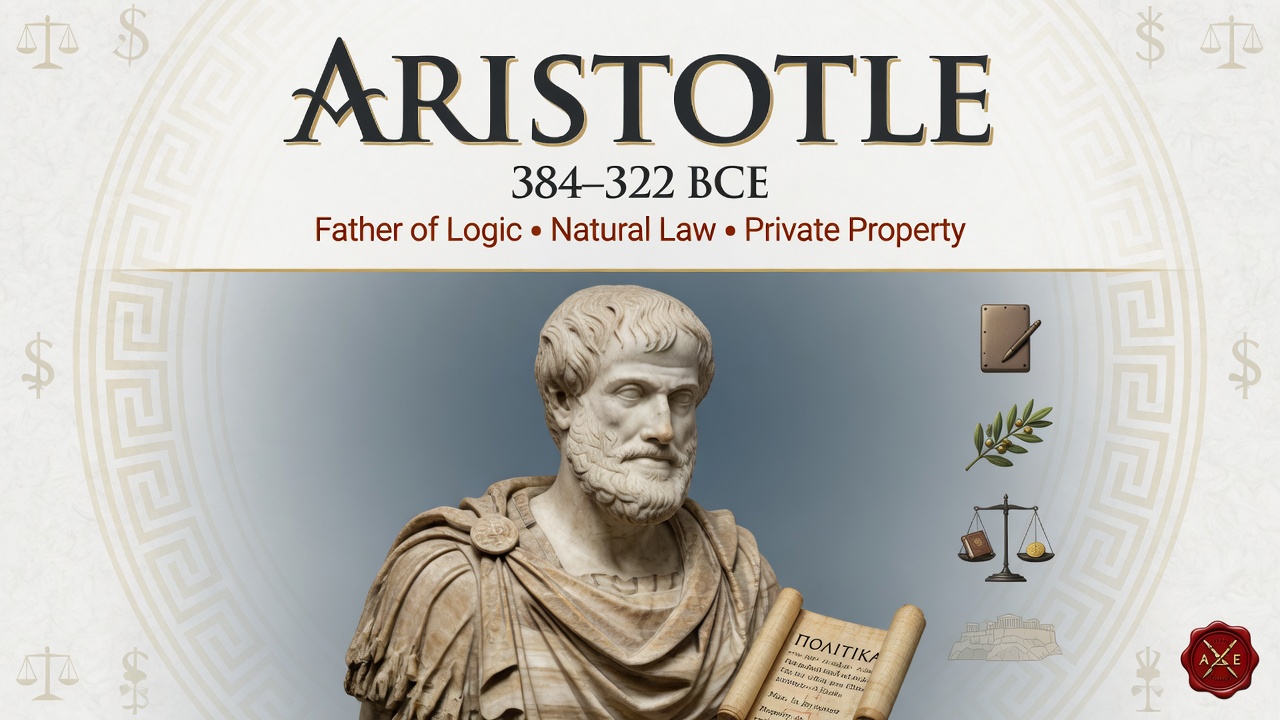
The concept originates with Aristotle (384–322 BCE), who identified four causes of change, with the final cause (telos) being the purpose or end toward which something naturally tends. For Aristotle, acorns grow into oaks because that is their telos; humans pursue eudaimonia (flourishing or happiness) as their proper end through virtuous activity. This teleological framework influenced medieval natural law theory, particularly through Thomas Aquinas, who integrated Aristotelian purpose with Christian ethics: natural law reflects the rational order implanted in creation, directing humans toward their true ends.
Libertarian / anarcho-capitalist thinkers have drawn selectively from this tradition. While sometimes rejecting supernatural, and always rejecting collectivist interpretations, they retain the insight that human beings possess a nature oriented toward self-directed flourishing. Aristotle’s emphasis on the individual as a rational, purposeful agent underpins arguments for self-ownership and the right to pursue one’s own ends without being treated as a mere means to others’ goals.
Teleology in Praxeology and Austrian Economics#
The most rigorous development of teleology within the intellectual lineage leading to anarcho-capitalism appears in Ludwig von Mises’ Praxeology—the science of human action. In Human Action (1949), Mises defines action as “purposeful behavior” or “conscious aiming at ends.” The fundamental axiom of praxeology is that humans act: they employ scarce means to achieve chosen ends under conditions of uncertainty. Economics is merely the most developed branch of this general theory of teleological conduct.
Murray Rothbard, the principal architect of modern anarcho-capitalism, extended Misesian praxeology into ethics and political theory. In The Ethics of Liberty (1982) and For a New Liberty (1973), Rothbard grounded natural rights in the teleological structure of human nature: individuals own themselves because they are purposeful actors who must control their bodies and the fruits of their labor to achieve any ends at all. Aggression against person or property violates this teleological reality by substituting the aggressor’s ends for the victim’s. Rothbardian anarcho-capitalism thus represents the consistent application of teleological reasoning: if humans are ends-directed agents, the only just social order is one of voluntary cooperation and absolute respect for self-ownership and property rights.
Hans-Hermann Hoppe and other Austro-anarchists have further refined these ideas, emphasizing the incompatibility between teleological human action (which presupposes mind, choice, and argumentation) and monistic or scientistic denials of purpose.
Teleology and the Anarcho-Capitalist Social Order#
In an anarcho-capitalist society, teleology operates at two levels:
Individual level: Every person remains free to define and pursue their own ends—whether material prosperity, artistic creation, spiritual exploration, family life, or adventure—using their own judgment and resources. Private property rights serve as the institutional embodiment of this freedom: they allow individuals to plan for the future, invest in means, and reap the consequences of their teleological choices.
Social level: Countless individual teleological actions spontaneously coordinate through the price system, entrepreneurship, and reputation mechanisms. No central planner needs to impose a collective telos. As F A Hayek observed in his writings on spontaneous order (building on Mises), the market is a discovery procedure in which dispersed knowledge and purposes are harmonized without anyone directing the overall outcome. Entrepreneurs anticipate future consumer ends; capitalists allocate resources toward the most valued uses; consumers reveal preferences through their choices. The result is an emergent order far more adaptive and welfare-enhancing than any designed teleology imposed by the state.
The state, by contrast, is inherently anti-teleological in practice. It substitutes political commands and bureaucratic goals for individual purposes, treating citizens as means to “society’s” ends (redistribution, regulation, conscription, or ideological projects). Even well-intentioned interventions distort the signals and incentives that allow personal teleology to flourish. Anarcho-capitalist defense, law, and infrastructure—provided competitively by private firms—align incentives with actual human purposes rather than with the ambitions of rulers or majorities.
Critiques of Anti-Teleological Views#
Modern scientism and collectivism often reject teleology in favor of mechanistic or holistic explanations. Behaviorism reduces humans to stimulus-response machines; Marxism subordinates individual ends to class or historical destiny; welfare-state liberalism imposes expert-defined “needs” or “social justice” outcomes. Most anarcho-capitalists counter that denying teleology is both descriptively false (humans demonstrably choose and plan) and normatively dangerous: it licenses treating people as raw material for utopian schemes.
In biology, the concept of teleonomy (apparent purpose arising from natural selection, as articulated by Ernst Mayr and others) acknowledges functional design without invoking conscious intent. For conscious human beings, however, genuine teleology—deliberate pursuit of self-chosen ends—remains irreducible. Anarcho-capitalism is uniquely compatible with this reality because it refuses to override individual purposes with collective ones.
Contemporary Relevance#
Advances in technology amplify the importance of teleological freedom. Cryptography, decentralized networks, 3D printing, and artificial intelligence empower individuals to pursue highly personalized ends with less dependence on centralized institutions. At the same time, state surveillance and regulatory regimes increasingly attempt to steer or monitor human purposes. Anarcho-capitalist analysis of these developments—drawing on praxeology and the logic of private property—reveals both the threats and the opportunities for expanding the domain of voluntary, purpose-driven action.
Teleology thus provides not only a philosophical foundation but a practical compass for anarcho-capitalist thought: a free society is one in which individuals may openly and peacefully strive toward whatever ends they judge worthwhile, coordinated only by mutual consent and the invisible hand of the market.
Further Reading
- Ludwig von Mises, Human Action (1949) – Chapters 1–4 on the nature of action.
- Murray Rothbard, The Ethics of Liberty (1982) – Especially Part I on natural law and self-ownership.
- Aristotle, Nicomachean Ethics and Politics (selections on eudaimonia and the polis).
- F.A. Hayek, “The Use of Knowledge in Society” (1945) – On emergent coordination of individual purposes.