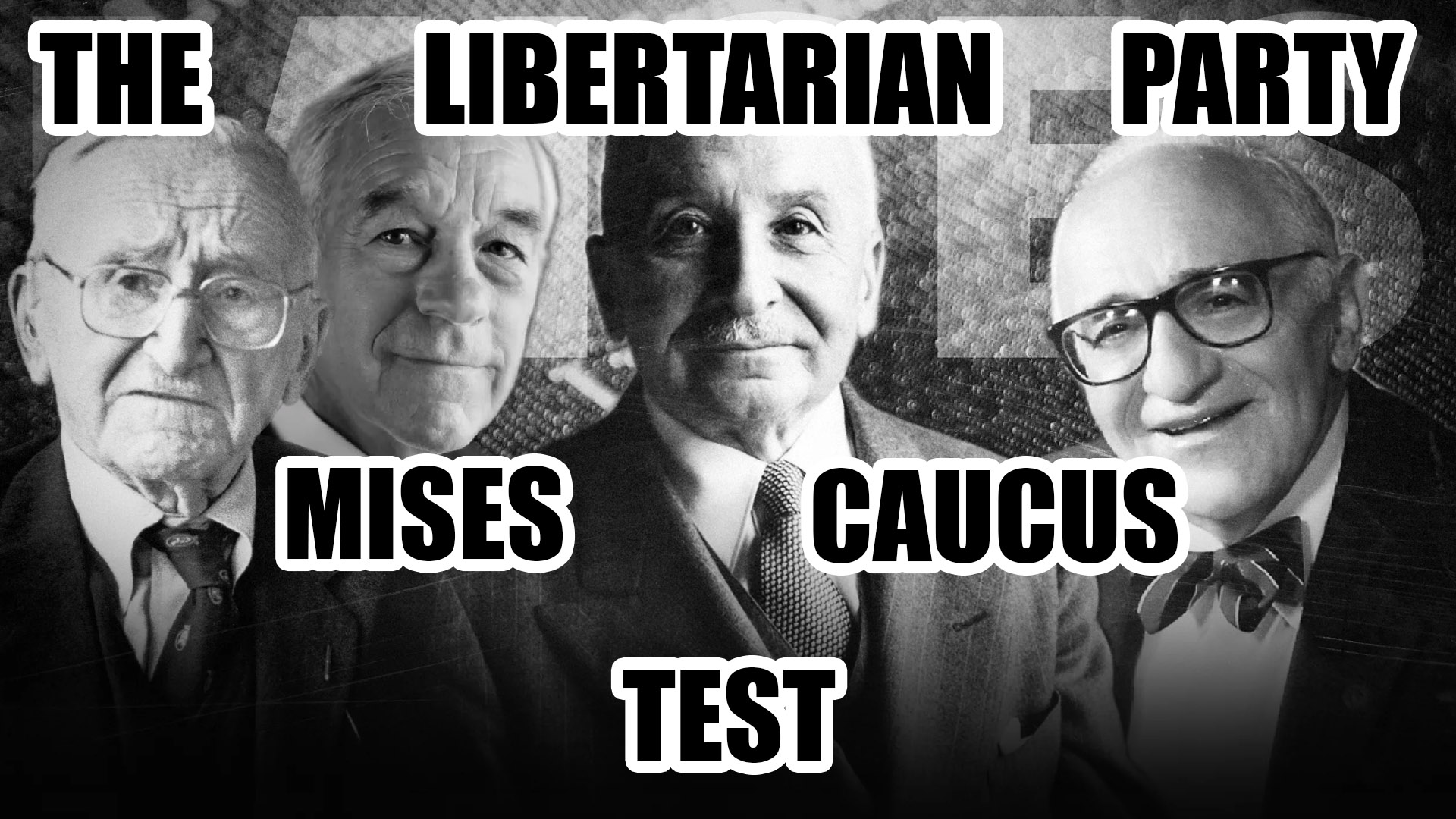
The Libertarian Pahtay Mises Caucus (LPMC), commonly known as the Mises Caucus, is a paleolibertarian faction and registered Political Action Committee (PAC, registration no. C00699785) within the United States Libertarian Pahtay (LP). Founded in 2017 by Michael Heise, it seeks to realign the LP toward the ideas of economist Ludwig von Mises, the Austrian School of economics, and the non-interventionist, anti-establishment campaigns of Ron Paul. The caucus emphasizes property rights, radical decentralization, opposition to central banking and war, and a rejection of “woke” cultural politics.
From an anarcho-capitalist perspective, the Mises Caucus represents an instructive but ultimately flawed experiment in working within the state’s political machinery. While it invokes Austrian economics and the non-aggression principle (NAP) in ways that superficially align with market anarchism—particularly its calls for secession “all the way down to the individual” and the complete separation of state from money and banking—it remains committed to electoral reformism and party politics. True anarcho-capitalists, who view the state as an illegitimate monopoly on violence that must be abolished through private law, markets, and voluntary association rather than captured or reformed, have long seen such efforts as legitimizing the very system they oppose. This critique intensified dramatically after the 2024 presidential election cycle, when contemporary anarcho-capitalists largely rejected the caucus as having devolved into a de facto vehicle for right-wing fusionism and Donald Trump support.
History#
The Mises Caucus emerged in 2017 amid internal LP tensions. Michael Heise founded it in opposition to then-LP Chair Nicholas Sarwark and the pragmatic “Pragmatist” or “Johnsonite” faction associated with former New Mexico Governor Gary Johnson’s 2012 and 2016 presidential runs, which critics in the caucus viewed as diluting libertarian principles with moderation and cultural progressivism. The group drew inspiration from the Mises Institute and paleolibertarian thinkers, positioning itself as the “libertarian wing” of the LP. Early activities included the 2019 launch of the Mises PAC for fundraising and candidate support.
The caucus achieved national prominence at the 2022 Libertarian National Convention in Reno, Nevada (“the Reno Reset” or “Takeover”). Supported by figures like comedian Dave Smith, it swept control of the Libertarian National Committee (LNC), electing Angela McArdle as LP National Chair with approximately 69-70% of the vote. This shift led to platform changes (e.g., removal of explicit anti-bigotry language), some state affiliate disaffiliations (New Mexico, Virginia, Massachusetts), and internal lawsuits over control of affiliates. The caucus promoted local activism, opposition to COVID-19 mandates, and “peaceful separation” or “national divorce” rhetoric.
Leadership and Structure#
As a PAC headquartered in Norristown, Pennsylvania, the Mises Caucus operates with a board of directors and state-level organizers focused on local elections, issue coalitions, and LP convention delegate recruitment. It maintains a national structure for training candidates, grassroots organizing, and cultural outreach (“liberty culture”).
Key leadership timeline:
- Founder/Chair Michael Heise (2017–2023): Primary strategist and organizer.
- Aaron Harris (2023–June 2025): Interim chair.
- Angela McArdle (June 2025–present): Current Chair of the Mises Caucus (after serving as LP National Chair until her January 2025 resignation).
Notable associated figures include Dave Smith (comedian and podcaster), Tom Woods, Scott Horton, and Ron Paul (described as de facto inspiration). The board has included David Hynes (Secretary), Kyle Burton (Treasurer), and others such as Brodi Elwood, Jeffrey Douglas, and Luke Ensor.
Platform and Prominent Works#
The caucus’s platform, outlined on its official site, centers on a “Four-Point Decentralized Revolution Strategy”: party organizing, candidate training/support (focused on local races to nullify higher laws), issue coalitions, and building a “liberty culture” through media and events informed by Austrian economics. Core principles include:
- Absolute private property rights derived from self-ownership and the NAP.
- Endorsement of the Austrian School as the basis for economic policy.
- Complete rejection of central banking, fiat currency, and state monetary intervention in favor of competing private currencies.
- Radical decentralization, secession, nullification, and subsidiarity “all the way down to the individual.”
- Non-interventionist foreign policy, ending the “empire,” and transitioning defense to the free market.
- Rejection of identity politics, corporatism, and “absentee tyranny” (state withdrawal that prevents genuine market governance).
Prominent works and initiatives include:
- Project Decentralized Revolution and the Beginner’s Guide to the LP (practical resources for newcomers on conventions, bylaws, and activism).
- Delegate training and convention organizing tools.
- Support for local candidates and issue-based coalitions.
- Cultural outreach tied to allied media, such as Dave Smith’s Part of the Problem podcast, Tom Woods Show episodes, and events featuring Ron Paul.
From an anarcho-capitalist viewpoint, these efforts highlight useful Austrian insights and anti-state rhetoric but fall short by treating the LP as a viable vehicle to play politics rather than rejecting electoralism outright in favor of agorism, private defense agencies, and polycentric law.
2024 Activities and Alignment with Donald Trump#
At the 2024 Libertarian National Convention, the Mises Caucus retained influence over the LNC (McArdle was re-elected Chair). The group endorsed Michael Rectenwald for president (who received about 45% in primaries but lost the nomination to Classical Liberal Caucus candidate Chase Oliver) and Clint Russell for vice president. Most notably, Chair Angela McArdle invited Donald Trump to address the convention; Trump spoke and urged libertarians to support him. McArdle and other caucus voices expressed strategic openness to Trump alignment. Critics, including within the LP, accused the caucus of turning the party into a right-wing spoiler or auxiliary to the Republican Party.
Post-election, with Trump victorious and absorbing a notable share of potential LP voters, the caucus faced internal fractures: McArdle resigned as LP National Chair in January 2025, and founder Michael Heise lost a special election for the position (9-6 vote) to Steven Nekhaila.
Contemporary Anarcho-Capitalist Rejection#
Contemporary anarcho-capitalists—those aligned with the traditions of Murray Rothbard (in his stateless phase), Hans-Hermann Hoppe’s private covenant communities, or agorist strategies—have fully distanced themselves from the Mises Caucus following the 2024 cycle. While some paleolibertarians and minarchists initially saw value in the caucus’s “Reno Reset” and Austrian focus, pure anarcho-capitalists view its evolution as a textbook case of political capture: prioritizing fusionism with the populist right, Trump-adjacent rhetoric, and electoral pragmatism over the abolition of the state. The invitation of Trump, support for candidates with culturally conservative or restrictionist views (e.g., on immigration), and the perception that the LP under Mises influence functioned more as a PAC to siphon votes or bolster Trump than to advance liberty, led to widespread dismissal. Many anarcho-capitalists now point to the separate Radical Caucus within the LP as the more ideologically consistent (if still imperfect) vehicle, or reject LP involvement entirely in favor of building parallel institutions outside the state.
Declining LP fundraising, membership losses, and state-level schisms under caucus influence further reinforced the anarcho-capitalist critique that engaging the political process inevitably leads to compromise and irrelevance for achieving a stateless society.
External Links
- Official website: lpmisescaucus.com
- Platform: lpmisescaucus.com/platform