
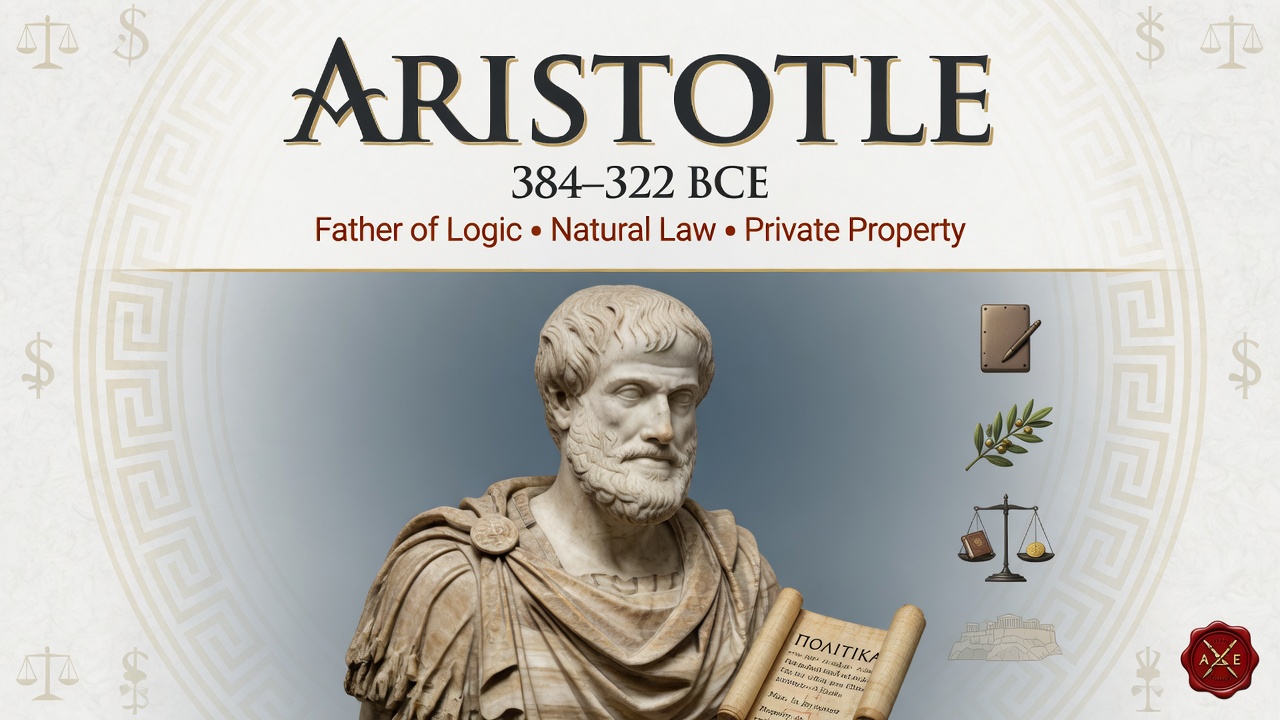
Aristotle (384–322 BC) was an ancient Greek philosopher, scientist, and polymath whose empirical method, defense of private property, and natural-law ethics laid foundational stones for the Western tradition of rational inquiry and individual liberty. Aristotle stands as a proto-libertarian thinker who rejected collectivist utopias, championed the moral and practical superiority of private ownership, and rooted human flourishing (eudaimonia) in reason and voluntary action rather than coercive state power. His ideas profoundly influenced later natural-rights theorists, from Thomas Aquinas to Murray Rothbard, providing intellectual ammunition against statism and for a society of free individuals, private Property, and emergent order.
Biography#
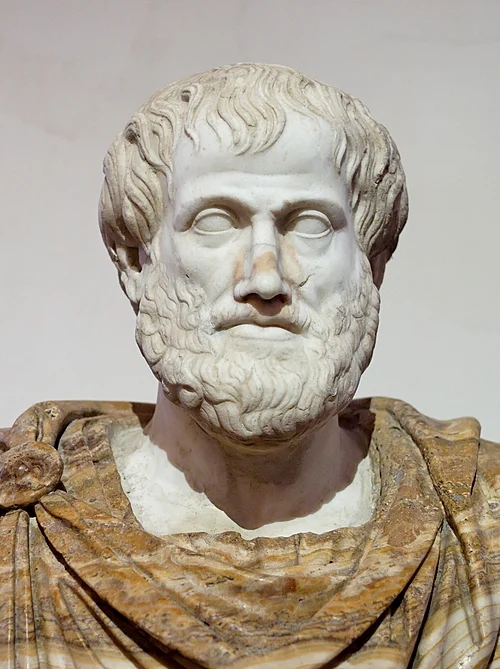
Aristotle was born in 384 BC in Stagira, a Greek colony in Chalcidice (modern northern Greece), to Nicomachus, court physician to King Amyntas III of Macedon, and Phaestis. Orphaned young, he was raised by a guardian and, at around age 17–18, entered Plato’s Academy in Athens, where he remained for nearly 20 years as student and colleague until Plato’s death in 347 BC.
After leaving the Academy, Aristotle traveled to Asia Minor and the island of Lesbos, conducting pioneering empirical research in marine biology and botany alongside Theophrastus. He married Pythias (daughter of the ruler Hermias of Atarneus) and had a daughter. In 343/342 BC, at the invitation of Philip II of Macedon, he became tutor to the young Alexander the Great in Pella—a role that lasted several years and gave him unique insight into monarchy and empire.
Returning to Athens in 335 BC, Aristotle founded his own school, the Lyceum (also called the Peripatetic school because of its practice of walking while lecturing). There he built an extensive library, systematized knowledge across dozens of fields, and taught until 323 BC. Following Alexander’s death and rising anti-Macedonian sentiment in Athens, he fled to Chalcis on Euboea, where he died in 322 BC at age 61 or 62, reportedly of a stomach ailment. He left his works and library to Theophrastus.
Aristotle was married twice (his second companion was Herpyllis, mother of his son Nicomachus). His life bridged the classical Greek polis and the Hellenistic world, combining rigorous observation with systematic philosophy.
Philosophical Contributions from an Anarcho-Capitalist Perspective#
Anarcho-capitalists view Aristotle not primarily as a statist philosopher of the polis but as a rationalist who supplied the ethical and economic foundations for liberty. His teleological view of human nature—man as a rational animal whose proper end is eudaimonia (flourishing) achieved through virtuous activity—aligns closely with the anarcho-capitalist emphasis on self-ownership, voluntary cooperation, and the pursuit of happiness in a stateless society. Murray Rothbard explicitly drew upon the Aristotelian-Thomistic natural-law tradition to ground objective ethics in human nature rather than positive law or divine command.
The Defense of Private Property#
Aristotle’s most direct contribution to libertarian thought appears in Politics (Book II), where he systematically dismantles Plato’s proposal for communal ownership of property (and, in the ideal case, of wives and children) among the guardian class. He offers four interlocking arguments that remain central to anarcho-capitalist defenses of property rights:
Efficiency and Incentive: “People pay most attention to what is their own; they care less for what is common.” Private property prevents the Tragedy of the Commons; individuals steward resources more carefully when they reap the rewards (or bear the losses).
Social Harmony and Unity: Communal property generates constant conflict and resentment. Separate ownership creates clear boundaries and reduces quarrels: “Those who own common property… are far more at variance with one another than those who have property separately.”
Justice: Justice requires proportionality—“if people are not equal, they will not possess equal things.” Private property allows rewards to track individual effort, talent, and voluntary exchange rather than enforced equality.
Virtue and Moral Agency: Generosity, friendship, and charity are possible only when individuals control their own resources. “Doing favors and helping friends… only happens when property is private.” Virtue requires voluntary choice; communal systems destroy moral responsibility by eliminating personal ownership.
Anarcho-capitalists see these arguments as an early, powerful case for homesteading, private property, and free markets. They prefigure Rothbard’s and Hoppe’s insistence that property rights are the foundation of social order and that aggression against justly acquired property is the root of injustice. Aristotle’s rejection of radical egalitarianism and his recognition that human nature makes pure communism unworkable remain devastating critiques of socialist and communist schemes.
Natural Law, Reason, and the Ethics of Liberty#
Aristotle’s ethics in the Nicomachean Ethics centers on eudaimonia as the highest good—rational activity in accordance with virtue, practiced over a complete life. This teleological natural-law framework supplies one of the most popular, though not unconstested, philosophical backbones for anarcho-capitalist ethics: human beings have discoverable natures and ends; reason can identify the requirements of flourishing (self-ownership, non-aggression, voluntary exchange). Rothbard built his Ethics of Liberty squarely on this tradition, arguing that natural law provides an objective basis for rights independent of any state.
You can see Patrick Smith and Christian Moore provide some of the counter arguments to Rothbards theory here:
Aristotle’s golden mean (virtue as the rational middle between extremes) and his emphasis on practical wisdom (phronesis) support the anarcho-capitalist vision of decentralized, customary law emerging from free individuals rather than top-down legislation.
Economic Insights and Austrian Affinities#
In Politics and the Nicomachean Ethics, Aristotle analyzed money as a conventional medium that makes goods commensurable and facilitates exchange—anticipating the Austrian insight that money arises from the market process to solve the problem of the double coincidence of wants. Rothbard praised Aristotle’s recognition of subjective valuation in exchange while critiquing his residual Platonic hostility to retail trade and usury as “unnatural.” Nevertheless, Aristotle’s empirical, observational approach to economics aligns with the Austrian School’s methodological individualism and praxeology far more than with later objective-cost or labor theories.
Political Theory and Skepticism of Coercive Power#
While Aristotle famously declared “man is by nature a political animal,” he meant that humans naturally form voluntary communities for the good life, not that the coercive state is inevitable or desirable. He classified constitutions, favored mixed regimes and the rule of law over pure democracy (which he viewed as prone to mob rule and redistribution), and warned against the concentration of power. Anarcho-capitalists read these passages as proto-polycentric: law and order can emerge from custom, reputation, and competing institutions rather than a monopolistic state. Aristotle’s critique of extreme democracy and his preference for limited, lawful government resonate with modern arguments for private defense agencies and competing legal systems.
Aristotle’s support for slavery and certain forms of monarchy must be understood as historically contingent errors common to his era; they do not negate his broader rationalist and property-centered framework, which later thinkers (including Rothbard) refined into consistent anti-statism.
Major Works#
Aristotle’s surviving corpus (about one-third of his output) covers an astonishing range. The most relevant to liberty and anarcho-capitalist thought include:
- Nicomachean Ethics — Virtue ethics, eudaimonia, the golden mean, friendship, and justice as a mean. Foundation for natural-law ethics of liberty.
- Politics — Constitutions, private property defense, economics of the household and city, critique of Plato. Essential reading for property-rights theory.
- Metaphysics — Being, substance, potentiality and actuality, unmoved mover. Underpins a rational, ordered universe knowable by reason.
- Organon (logical works, especially Prior Analytics and Posterior Analytics) — Syllogistic logic and scientific method. The toolset for clear reasoning and argumentation ethics in a free society.
- Physics and On the Soul — Natural philosophy and psychology; empirical observation of causes and human nature.
- Rhetoric and Poetics — Persuasion and literary theory; tools for peaceful resolution of disputes through reason and language.
Many works survive only in fragments or medieval Latin/Arabic translations; the systematic editions we possess were likely lecture notes compiled by students.
Legacy in the Tradition of Liberty#
Aristotle’s influence on anarcho-capitalism is indirect but profound. Through Thomas Aquinas and the Scholastics, his natural-law ethics entered the Western canon and informed later classical-liberal and libertarian thinkers. Rothbard repeatedly situated himself in the Aristotelian-Thomistic line, using it to combat both positivism and Kantian subjectivism. In An Austrian Perspective on the History of Economic Thought, Rothbard treats Aristotle as a pivotal early economist whose insights into exchange and money deserve serious attention despite flaws.
Modern anarcho-capitalists continue to cite Aristotle’s property arguments as among the earliest and strongest philosophical defenses of private ownership against collectivism. His empirical rationalism, rejection of utopian central planning, and focus on individual virtue and flourishing supply enduring intellectual resources for a stateless society based on consent, property, and voluntary cooperation.
In an age of resurgent statism and identity politics, Aristotle’s insistence that reason, not force or majority whim, discovers justice remains a beacon for those who seek liberty through private property and free markets.
Further Reading
- Murray Rothbard, An Austrian Perspective on the History of Economic Thought, Vol. 1 (Aristotle chapter).
- FEE.org and Libertarianism.org articles on Aristotle’s defense of private property.
- Hans-Hermann Hoppe’s works on argumentation ethics and property (building on Aristotelian foundations).
