Ayn Rand (born Alisa Zinovyevna Rosenbaum; February 2, 1905 – March 6, 1982) was a Russian-American novelist, screenwriter, and philosopher best known for developing Objectivism, a system of thought that places the individual, reason, and rational self-interest at the center of human existence. Her best-selling novels The Fountainhead (1943) and Atlas Shrugged (1957) dramatized a heroic vision of productive achievement, private property, and laissez-faire capitalism while fiercely condemning collectivism, altruism, and statism. From an anarcho-capitalist perspective, Rand stands as a towering figure in the intellectual defense of liberty: she provided the moral and philosophical ammunition against socialism and welfare-statism that helped launch the modern liberty movement. Her uncompromising celebration of the “producers” and rejection of sacrificial ethics inspired generations of libertarians. However, anarcho-capitalists regard her insistence on a minimal “night-watchman” state as a critical inconsistency in her own principles. While she correctly identified the non-initiation of force as the foundation of a free society, her defense of a coercive government monopoly on retaliatory force is seen as incompatible with the full application of voluntary market mechanisms to law, defense, and dispute resolution.
1943 Talbot portrait used on the first-edition back cover of The Fountainhead: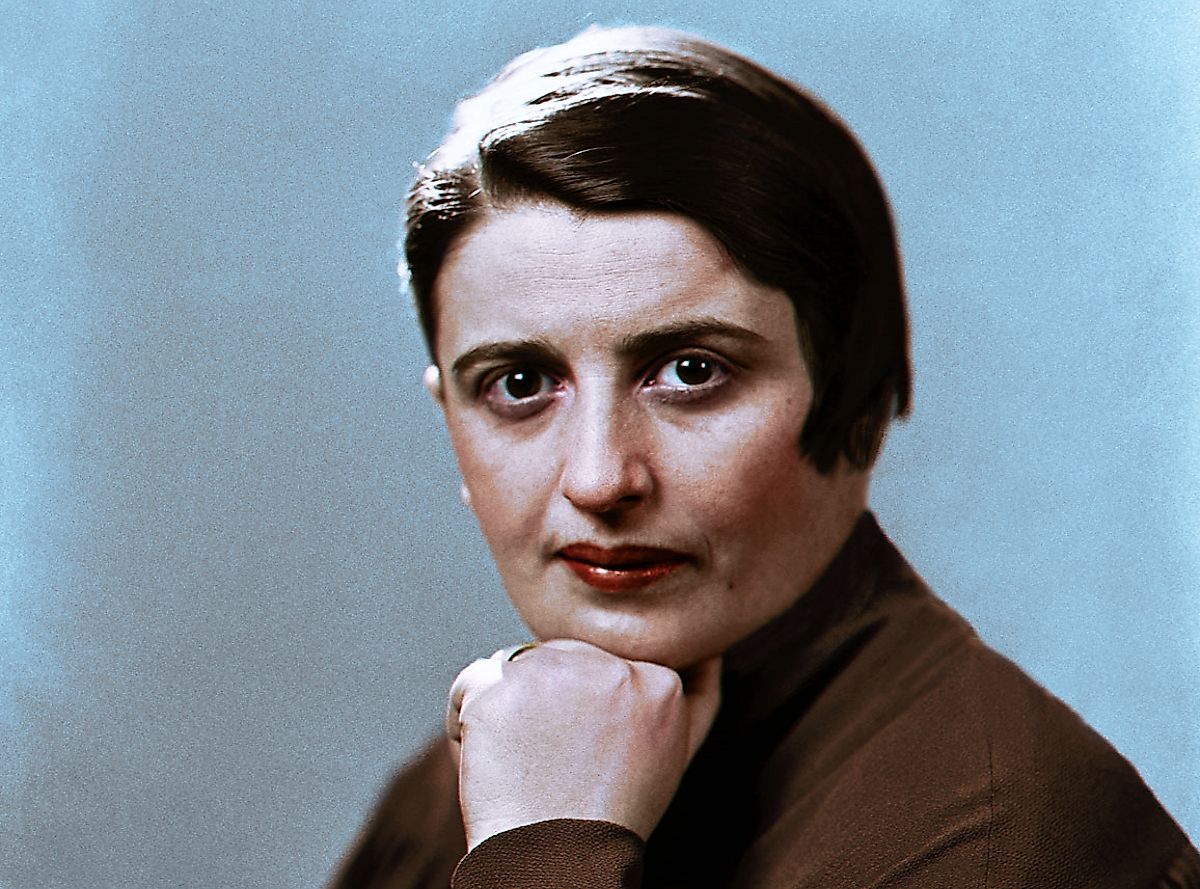
Early Life#
Alisa Zinovyevna Rosenbaum was born into a middle-class Jewish family in Saint Petersburg, Russia. Her father, Zinovy Rosenbaum, owned a successful pharmacy that was nationalized after the Bolshevik Revolution of 1917. The family experienced firsthand the terror, poverty, and moral inversion of Soviet collectivism: property seized, food rationed by political loyalty, and independent thought branded as treason. These formative experiences forged Rand’s lifelong hatred of statism and her identification of altruism as the moral root of tyranny. She taught herself to read at age six and decided at nine to become a writer. After graduating from the University of Petrograd in 1924, she briefly studied screenwriting before leaving the Soviet Union forever in 1926.
Immigration and Literary Career#
Arriving in the United States with $50 and a typewriter, she adopted the pen name Ayn Rand (the first name reportedly inspired by a Finnish writer, the last a shortening of her Russian surname). She worked odd jobs in Hollywood, including as a movie extra and script reader, before breaking through as a playwright and novelist. Her first major novel, We the Living (1936), was a semi-autobiographical indictment of Soviet Russia. The dystopian novella Anthem (1938) depicted a future collectivist hell where the word “I” has been erased. The Fountainhead (1943) brought her fame; its hero, architect Howard Roark, embodies uncompromising individualism and creative integrity. Atlas Shrugged (1957), her magnum opus, is an epic “mystery story” in which the world’s producers go on strike against looters and regulators, dramatizing Objectivism in full. After 1957 she devoted herself almost exclusively to non-fiction essays and lectures promoting her philosophy.
Philosophy of Objectivism#
Rand named her system Objectivism and summarized it as “the concept of man as a heroic being, with his own happiness as the moral purpose of his life, with productive achievement as his noblest activity, and reason as his only absolute.” Its core tenets are:
- Metaphysics: Reality exists independently of consciousness (primacy of existence).
- Epistemology: Reason is man’s only means of knowledge; faith and emotion are not tools of cognition.
- Ethics: Rational self-interest (“selfishness” in her precise sense) is the highest virtue; altruism—the sacrifice of oneself or others—is a vice.
- Politics: The only proper social system is laissez-faire capitalism, based on voluntary trade and the non-initiation of force.
Objectivism rejects both religious conservatism and left-wing collectivism, insisting that rights derive from man’s nature as a rational being and that the only moral function of force is retaliatory.
Views on Government and Critique of Anarchism#
Rand was a committed minarchist. In essays such as “The Nature of Government” (The Virtue of Selfishness, 1964) she argued that a single, objective agency with a monopoly on retaliatory force is required to protect individual rights and prevent the chaos of competing private “protection” agencies. She dismissed anarchism as a “naive floating abstraction” that would devolve into gang warfare. Anarcho-capitalists respectfully but firmly disagree. They contend that Rand’s own principles—the non-initiation of force, the primacy of voluntary contract, and the impossibility of a rights-protecting monopoly that is funded by coercion—logically lead to market anarchism. Private defense agencies, arbitration firms, and reputation-based law can and do provide objective protection more efficiently than any state. Roy A. Childs Jr.’s famous 1969 open letter to Rand (“Objectivism and the State”) made precisely this case: if government is defined by its coercive monopoly, then Objectivism’s own logic demands its abolition.
Influence on Anarcho-Capitalism#
Despite her explicit rejection of anarchism, Rand’s impact on the anarcho-capitalist tradition is immense. Atlas Shrugged introduced countless readers to the morality of capitalism and the evil of the “looters.” Her defense of rational egoism, private property, and the harmony of interests under free markets supplied the ethical foundation that Murray Rothbard and later thinkers built upon when they radicalized her politics into full anarcho-capitalism. Many prominent anarcho-capitalists (Rothbard himself in his early years, David Friedman, and countless others) began as Objectivists before concluding that the market can supply every service—including rights protection—without a coercive state. Rand’s novels remain among the most effective popularizers of anti-statist ideas ever written; her non-fiction essays on the “unknown ideal” of capitalism continue to be required reading in liberty circles.
Anarcho-capitalists value Rand for:
- Popularizing the moral case for capitalism against both socialists and “mixed-economy” conservatives.
- Ruthlessly exposing altruism as the moral sanction of tyranny.
- Championing the producer as the hero of civilization.
They critique her for:
- Inconsistently applying the non-aggression principle to government itself.
- Creating an insular “Objectivist” movement that treated dissent (especially on the state question) as heresy.
- Underestimating the ability of competitive markets to produce law and security.
Legacy#
Ayn Rand died of heart failure in New York City on March 6, 1982. Her books have sold tens of millions of copies and remain in print worldwide. From an anarcho-capitalist viewpoint, her greatest legacy is the demonstration that capitalism is not merely efficient but moral—the only system consonant with man’s nature as a rational, volitional being. While she stopped short of the full privatization of defense and adjudication, the intellectual tools she forged make the completion of that project possible. Anarcho-capitalism can be understood, in part, as Objectivism taken to its logical political conclusion: a society of free individuals interacting solely by consent in every domain, including the protection of rights.
Selected major works
Fiction
- We the Living (1936)
- Anthem (1938)
- The Fountainhead (1943)
- Atlas Shrugged (1957)
Non-fiction (key titles)
- The Virtue of Selfishness (1964)
- Capitalism: The Unknown Ideal (1966)
- Introduction to Objectivist Epistemology (1967/1979)
- The Romantic Manifesto (1969)
Rand’s ideas remain a vital starting point for anyone seeking a principled defense of liberty. Anarcho-capitalists honor her as a radical for capitalism who cleared the path; they simply continue the journey one step further—into a world where even the last remnant of coercive monopoly has been replaced by voluntary, market-driven order.