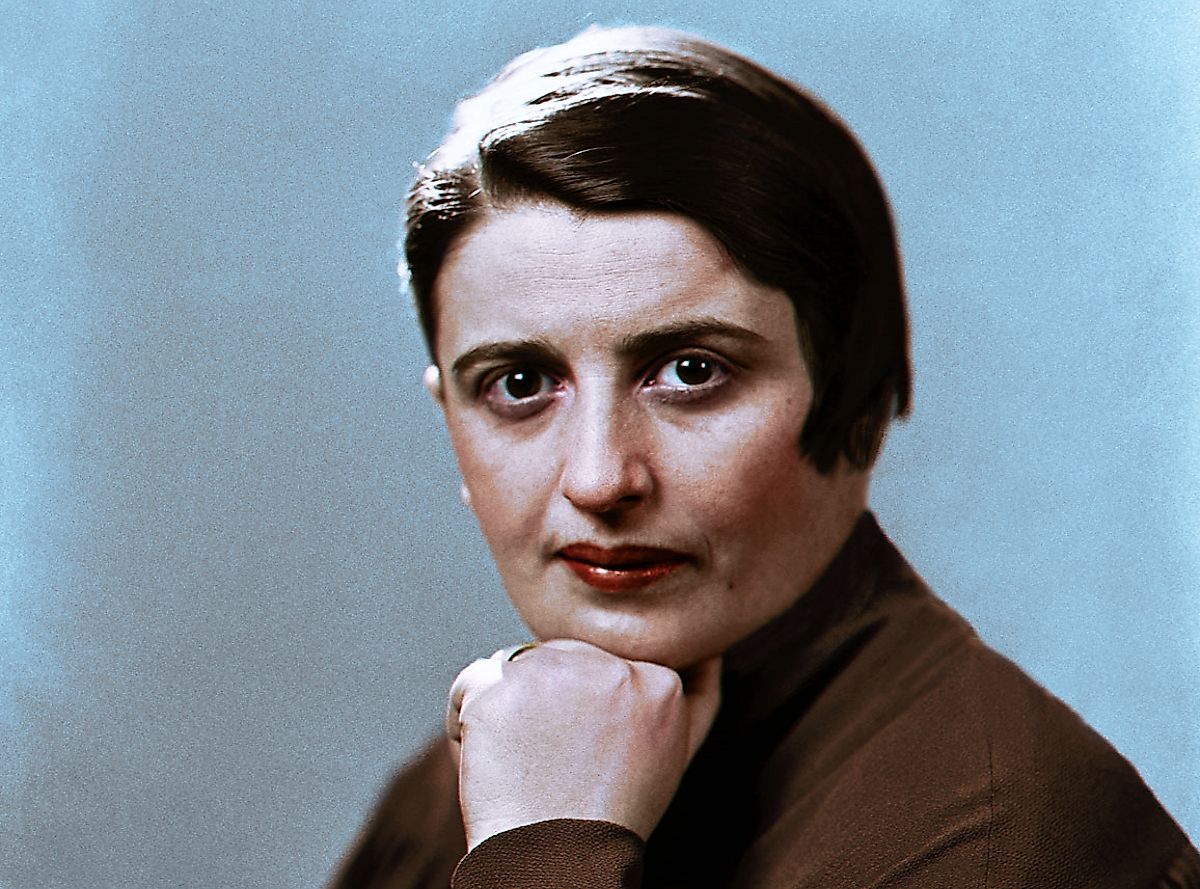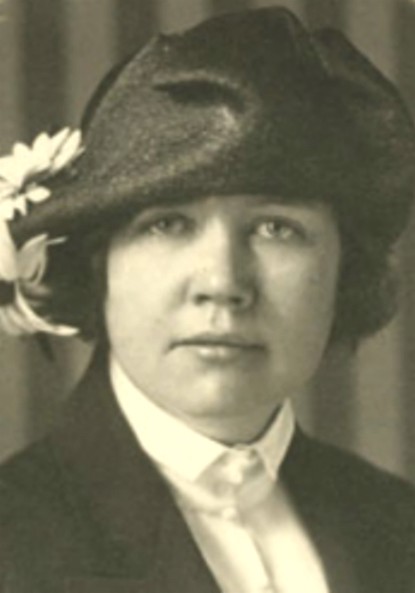
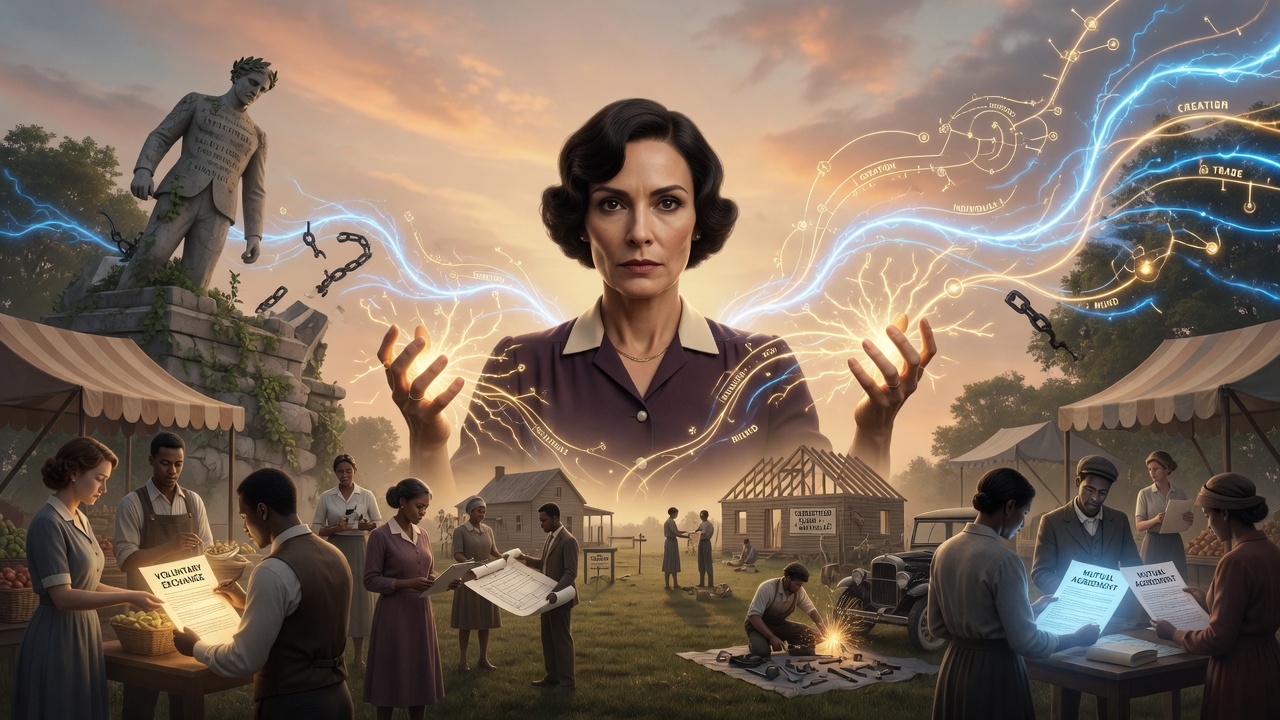
Isabel Paterson (January 22, 1886 – January 10, 1961) was a Canadian-American novelist, journalist, literary critic, and political philosopher whose uncompromising defense of individualism, “private” property, and voluntary cooperation established her as one of the intellectual founders of modern libertarianism. Paterson’s work represents a powerful bridge between classical liberalism and the full rejection of the state: her analysis of human energy, the “Society of Contract,” and government as a parasitic “dead end” in the flow of productive power demolishes the moral and practical case for any coercive monopoly on force, pointing directly toward a stateless order of competing private defense agencies, restitution-based law, and purely voluntary exchange.
Historian Jim Powell described her, alongside Rose Wilder Lane and Ayn Rand, as one of the “three founding mothers of American libertarianism.” Her biographer Stephen D. Cox called her “the earliest progenitor of libertarianism as we know it today.” Ayn Rand herself declared that Paterson’s masterpiece The God of the Machine (1943) “could literally save the world.”
Early Life and Self-Education#
Born Isabel Mary Bowler on Manitoulin Island, Ontario, Paterson grew up in frontier poverty on a cattle ranch in Alberta as one of nine children. With only a few years of sporadic formal schooling, she educated herself through voracious reading and direct experience of productive work—waitressing, stenography, bookkeeping, and clerical labor for the Canadian Pacific Railway. These formative years instilled an unshakable conviction that human beings are self-starting “dynamos” whose creative energy flourishes only when unhindered by coercion.
She married briefly (1910–1918) and kept her husband’s surname after separation. By the 1910s she had moved into journalism in the American West and then New York, becoming a U.S. citizen in 1928.
Literary Career and Column#
From 1924 to 1949 Paterson wrote the influential “Turns with a Bookworm” column for the New York Herald Tribune, reviewing works by Hemingway, Fitzgerald, the Harlem Renaissance, and countless others with razor wit and philosophical depth. She also published several novels exploring themes of independence and the frontier spirit:
- The Shadow Riders (1916)
- The Magpie’s Nest (1917)
- The Singing Season (1924)
- The Fourth Queen (1926)
- The Road of the Gods (1930)
- Never Ask the End (1933)
- The Golden Vanity (1934)
These works, though less remembered than her nonfiction, consistently celebrated self-reliant individuals navigating hostile environments—early literary expressions of the same principles she would later systematize.
The God of the Machine (1943): The Anarcho-Capitalist Core#
Paterson’s enduring masterpiece is The God of the Machine, published the same year as Rand’s The Fountainhead and Lane’s The Discovery of Freedom. Using a brilliant engineering metaphor, she models society as an energy circuit in which creative individuals function as self-starting dynamos.
Key insight: “Energy is the medium of life.” Productive human action converts energy into wealth, knowledge, and civilization. Government, however, is not a generator of energy but a dead-end device—a brake or governor that can only cut off power to aggressors; it cannot create or direct productive energy without short-circuiting the entire system.
This framework aligns seamlessly with anarcho-capitalist analysis:
- Private property as the “inductor” that initiates the flow of energy. Without secure property rights, no circuit exists.
- The “Society of Contract” versus the “Society of Status.” In the former, individuals relate through voluntary agreement and mutual benefit—the natural order of free markets. In the latter (feudalism, socialism, the welfare state), people exist only by permission of rulers, operating at a “lower potential of energy.”
- Government as parasite. Every dollar taxed or regulation imposed diverts energy from production to coercion. Paterson’s famous chapter “The Humanitarian with the Guillotine” exposes coercive altruism: the welfare-state “philanthropist” requires victims to remain helpless so he can remain virtuous. True charity is voluntary, secondary to production, and never claims a right to loot producers.
Paterson demolished fiat money fallacies, “production for use not profit,” majority-rule collectivism, and the New Deal with surgical precision. Her constitutional analysis praised the original American framework as an “energy-liberator” while condemning later amendments that centralized power—insights that ancaps extend by arguing even the minimal state is unnecessary once private courts, insurance, and defense agencies can enforce natural rights through contract and reputation.
While Paterson herself advocated a strictly limited constitutional government, her logic is inexorable: if the state is merely a corrective inhibitor and not a source of value, why retain its monopoly at all? Anarcho-capitalists such as Murray Rothbard would later complete the argument by demonstrating that all “public goods” and dispute resolution can be supplied more efficiently and justly through the market.
Personal Character and Later Years#
Paterson was known for her sharp intellect, stylish independence, and refusal to compromise. She broke with both Ayn Rand (1948) and Rose Wilder Lane (1946) over personal and philosophical differences—yet her influence on Rand’s understanding of American history and capitalism remained profound. In retirement she declined Social Security, labeling it a “swindle” in an envelope she kept labeled accordingly.
She died in Montclair, New Jersey, on January 10, 1961, and was buried in Burlington, New Jersey.
Legacy#
Paterson’s ideas helped ignite the post-war libertarian renaissance. She influenced William F. Buckley Jr., Russell Kirk, Leonard Read, and countless others. Ron Paul later credited her with convincing him that “a philosophy that embraced personal liberty, private property, and sound money was the only political philosophy worth championing.”
For anarcho-capitalists, Paterson is more than a historical figure—she is a diagnostician of statism. Her energy-circuit model reveals why every expansion of government power, however well-intentioned, produces stagnation, dependency, and eventual collapse. Her celebration of the “Society of Contract” is the ethical and economic foundation of a pure market order. Her exposure of the “humanitarian with the guillotine” remains one of the most devastating critiques of the welfare-warfare state ever written.
In a world still dominated by coercive institutions, rereading The God of the Machine today feels prophetic: the only sustainable civilization is one in which every individual is free to act as a self-starting dynamo, connected to others solely through voluntary exchange, private property, and the non-aggression principle—precisely the society anarcho-capitalism seeks to build.
Further reading
- The God of the Machine (1943; modern editions with introduction by Stephen D. Cox)
- Stephen D. Cox, The Woman and the Dynamo: Isabel Paterson and the Idea of America (2004)
- Timothy Sandefur, Freedom’s Furies (2022) — the definitive collective biography of Paterson, Lane, and Rand
Paterson’s life and work stand as enduring proof that the creative individual—not the state—is the true engine of human progress. In the anarcho-capitalist vision she helped inspire, that engine will one day run at full power, unthrottled by any coercive “god of the machine.”