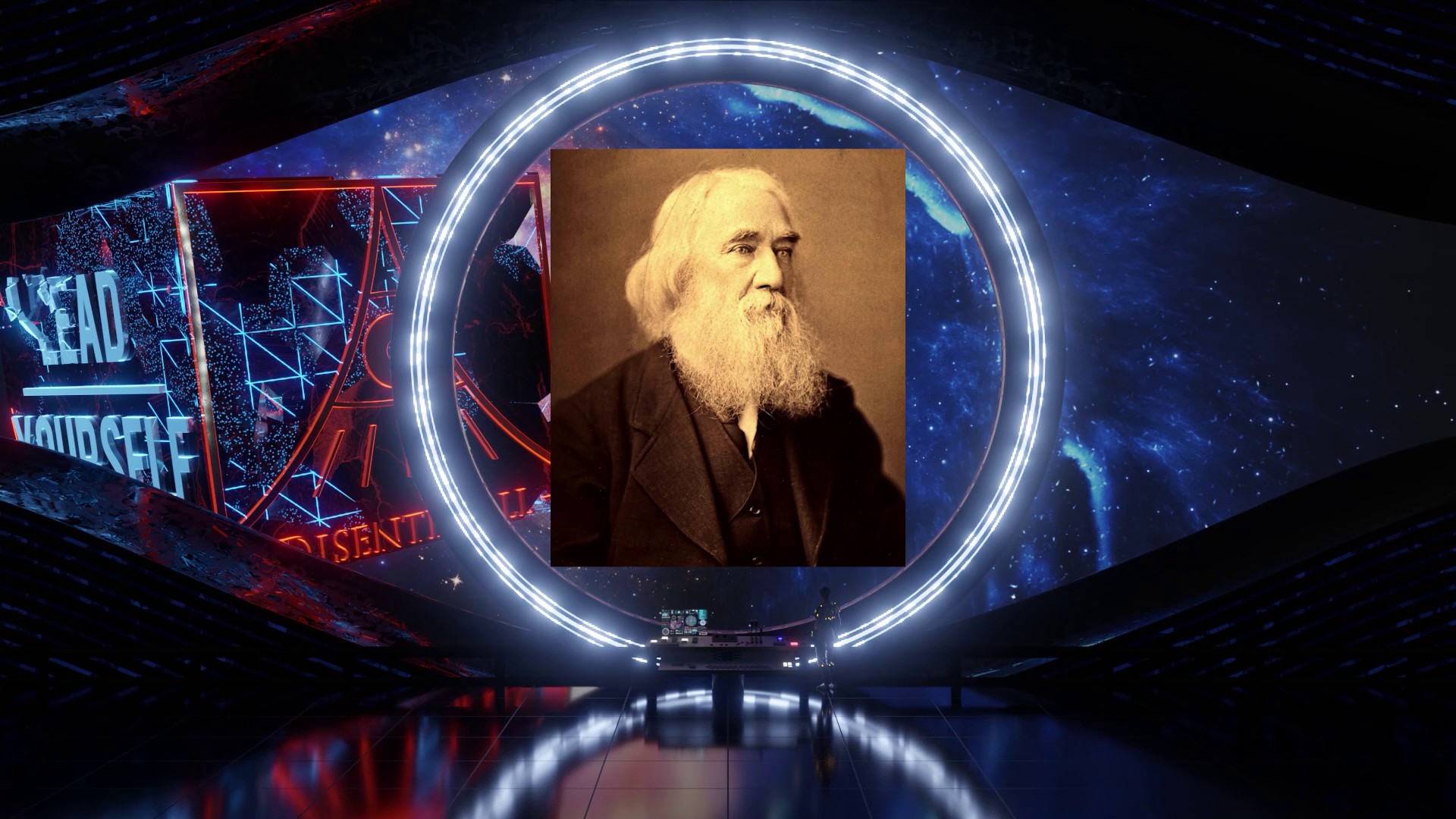
Lysander Spooner (January 19, 1808 – May 14, 1887) was an American individualist anarchist, abolitionist, lawyer, entrepreneur, and natural rights theorist whose uncompromising attacks on state legitimacy, constitutional authority, and victimless crime laws established him as one of the most radical and prescient thinkers in the libertarian tradition. From an anarcho-capitalist perspective, Spooner stands as a foundational precursor who demonstrated—through both action and rigorous argument—that voluntary markets, private property, natural law, and consensual associations can and should replace the coercive monopoly of the state. His life and writings reject all forms of involuntary government as criminal enterprises while championing individual sovereignty, free competition, and the non-aggression principle in its purest form.

Early Life#
Born on a small farm in Athol, Massachusetts, to Asa and Dolly Spooner, Lysander was the second of nine children in a family of modest means with deep New England roots tracing to a 1637 Plymouth settler. His father was a deist, and young Lysander absorbed a fierce independence and skepticism toward authority. He never attended college—an experience that later fueled his lifelong opposition to state-created barriers and professional monopolies that favored the privileged.
Spooner’s early defiance of arbitrary rules foreshadowed his later philosophy. In the 1830s he studied law privately under prominent Massachusetts figures including future governor John Davis and abolitionist Charles Allen. When state law required five years of apprenticeship for non-graduates (versus three for college men), Spooner practiced after only three years, openly challenging the courts. He won: the discriminatory rule was repealed in 1836. He viewed licensing laws as naked class legislation—“no one has yet ever dared advocate, in direct terms, so monstrous a principle as that the rich ought to be protected by law from the competition of the poor.” This episode encapsulates the anarcho-capitalist insight that state “protections” are almost always barriers to entry that entrench power.
The Postal Entrepreneur: Markets vs. Monopoly#
After a brief, unsatisfying legal career and a failed real-estate venture in Ohio, Spooner returned to Massachusetts. In 1844 he launched the American Letter Mail Company, a private postal service that directly competed with the U.S. Post Office monopoly. Using railroads, steamboats, and agents in major cities, the company offered faster, cheaper delivery and even introduced its own stamps. Spooner published The Unconstitutionality of the Laws of Congress Prohibiting Private Mails (1844), arguing that federal postal restrictions violated natural rights and the Constitution’s own limits.
The venture thrived commercially and forced the government to cut rates dramatically (from 5¢ to 3¢). Yet the state responded with force: the Postal Act of 1851 strengthened the monopoly, and Spooner’s company was crushed. This episode is paradigmatic—entrepreneurial innovation exposed the inefficiency and illegitimacy of state monopoly, delivered consumer benefits, and was then violently suppressed. It remains a classic illustration that “public” services are not natural monopolies but artificial ones maintained by aggression.
Abolitionism and the Natural Law Assault on Slavery#
Spooner became a leading voice in the radical abolitionist movement. His masterwork The Unconstitutionality of Slavery (1845, expanded 1860) contended that slavery violated natural law, the Declaration of Independence, and even the text of the U.S. Constitution itself when properly interpreted through principles of justice rather than political expediency. He defended fugitive slaves and condemned the Fugitive Slave Acts as criminal.
Unlike many abolitionists who sought to capture and reform the state, Spooner increasingly saw the entire apparatus of government—including the Constitution—as complicit in injustice. His later writings would make this explicit.
Major Works#
Spooner’s output was prodigious and consistently radical. Key texts include:
No Treason series (especially No Treason No. 6: The Constitution of No Authority, 1870) — Murray Rothbard called this “the greatest case for anarchist political philosophy ever written.” Spooner demolished the social-contract myth: no living person signed the Constitution; it binds no one without explicit, individual consent. Taxation is robbery; government officials are mere “banditti” who rule by force. The state has no more moral authority than any other criminal gang that claims a monopoly on violence.
Vices Are Not Crimes: A Vindication of Moral Liberty (1875) — A devastating critique of victimless crime laws. Spooner drew the crystal-clear distinction still central to anarcho-capitalism: vices are errors harming only oneself; crimes are acts invading another’s person or property. Punishing vices (drinking, gambling, prostitution, Sabbath-breaking, etc.) destroys liberty, property rights, and the very possibility of moral responsibility. “Unless this clear distinction… be made and recognized by the laws, there can be… no such thing as individual right, liberty, or property.”
Natural Law; or the Science of Justice (1882) — Spooner’s mature statement that justice is an objective science discoverable by reason, not the arbitrary commands of legislatures. All legislation is presumptively illegitimate; legitimate law arises from voluntary agreement and the defense of natural rights to life, liberty, and property.
Other important works include An Essay on the Trial by Jury (1852), which defended jury nullification as a popular check on state power, and various writings on currency, banking, and intellectual property that emphasized free competition and opposed legal privileges.
Philosophical Core: Natural Rights, Consent, and Stateless Order#
Spooner’s thought rests on three pillars that map directly onto anarcho-capitalist theory:
Natural Law and Individual Sovereignty — Rights to person and property are pre-political and inalienable. The state’s claim to override them by majority vote or “public policy” is pure usurpation.
The Illegitimacy of Involuntary Government — No constitution, democracy, or social contract binds anyone who has not personally consented. “A man’s natural rights are his own… he cannot be made a member of a corporation… without his own consent.” This is the intellectual foundation for rejecting the state entirely in favor of polycentric, voluntary legal orders.
Voluntary Association and Market Mechanisms — Legitimate protection, dispute resolution, and even “government” functions should arise from free contract and competition (private defense agencies, insurance, arbitration, mutual aid). Spooner’s own postal company proved the principle in practice.
While some modern interpreters emphasize Spooner’s mutualist or labor-oriented economic views (he favored certain banking reforms and criticized certain forms of exploitation), his core political philosophy—radical anti-statism, uncompromising natural rights, and the moral equivalence of state and private aggression—provides the ethical and strategic blueprint for anarcho-capitalism. Rothbard and later thinkers explicitly built upon Spooner’s demolition of constitutionalism and his vision of a society ordered solely by voluntary exchange and private justice.
Later Life and Death#
Spooner spent his final decades in Boston, writing, corresponding with fellow radicals, and defending individual conscience (including Millerites prosecuted under vagrancy laws). He never married and had no children. He died on May 14, 1887, at age 79 and is buried in Forest Hills Cemetery, Boston. His collected works (now widely available through the Liberty Fund and online archives) continue to inspire.
Legacy from an Anarcho-Capitalist Perspective#
Spooner’s influence on individualist anarchism and modern libertarianism is immense. Benjamin Tucker called him “our Nestor.” Murray Rothbard repeatedly praised him as the last great natural-rights theorist and the thinker who pushed Lockean principles to their logical, anarchist conclusion. Contemporary anarcho-capitalists see in Spooner the prototype of the activist-intellectual: someone who not only theorized stateless order but built competing institutions and exposed the state’s criminal nature with forensic precision.
His writings supply the moral ammunition for rejecting all state monopolies—on money, law, defense, mail, education, or morality. They demonstrate that a free society is not utopian but the natural outcome when individuals are left free to contract, innovate, and defend their rights without a privileged class of rulers extracting tribute by force.
In an age of expanding government power, surveillance states, and endless victimless-crime prosecutions, Lysander Spooner’s voice remains urgently relevant. He showed that the only just society is one in which every relationship is voluntary, every right is defended by consent, and the state—with all its pomp and coercion—is recognized as the greatest threat to liberty that humanity has ever faced.
Further Reading / Sources for Article Population
- Full texts: Liberty Fund’s Collected Works of Lysander Spooner; lysanderspooner.org
- Key secondary: Murray Rothbard’s introductions and essays on Spooner; works by Carl Watner and modern libertarian scholars.
Disenthrall Content featuring Lysander Spooner
Articles featuring Lysander Spooner