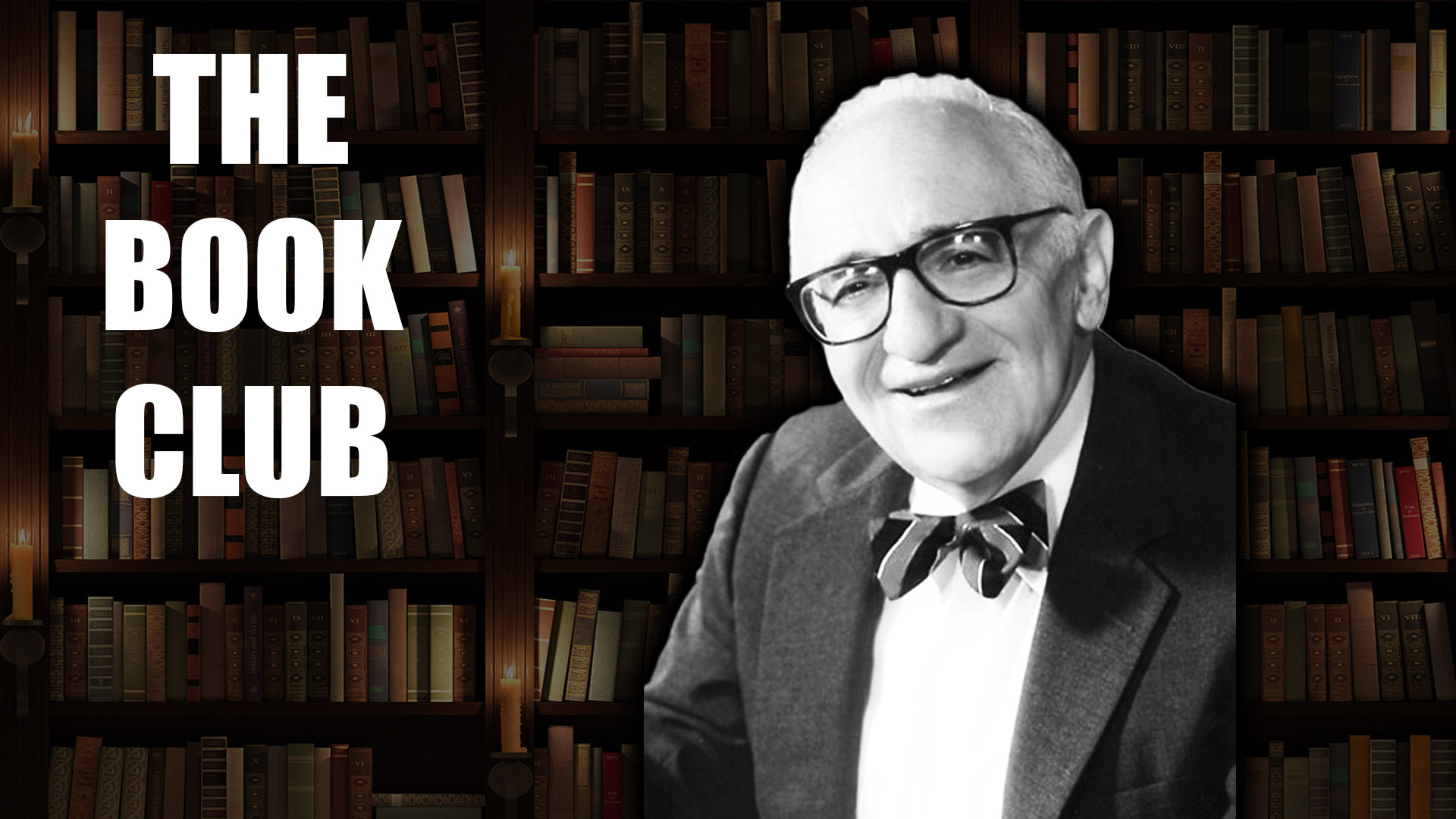
Murray Newton Rothbard (March 2, 1926 – January 7, 1995) was an American economist, historian, political theorist, and the principal founder and leading theoretician of anarcho-capitalism. He stands as one of the most rigorous and uncompromising defenders of individual liberty in the 20th century, synthesizing the praxeological methodology of the Austrian School of economics with a Natural Rights philosophy that demands the complete abolition of the state. Rothbard demonstrated that a fully private, voluntary society based on self-ownership, homesteading, and free exchange is not only possible but morally and economically superior to any form of government. His work provides the intellectual foundation for the modern anarcho-capitalist movement and remains essential reading for anyone serious about liberty.

Early Life and Intellectual Formation#
Born in New York City to Jewish immigrant parents—his father a chemist who instilled a deep appreciation for individualism, free enterprise, and merit—Rothbard grew up in a milieu that contrasted sharply with the prevailing collectivism of mid-20th-century intellectual life. He attended the private Birch Wathen School and later Columbia University, earning a B.A. in mathematics (1945) and a Ph.D. in economics (1956). His early political instincts leaned toward the Old Right: states’ rights, anti-interventionism, and skepticism of centralized power. As a young man he organized support for Strom Thurmond’s 1948 presidential campaign while still a student, reflecting his early commitment to decentralization.
Rothbard’s decisive intellectual awakening came through the works of Albert Jay Nock, Garet Garrett, Isabel Paterson, H.L. Mencken, and especially Ludwig von Mises. He attended Mises’s legendary New York University seminar and absorbed the Austrian insight that economics is a deductive science of human action (Praxeology), not an empirical or mathematical exercise. Unlike many of his contemporaries who compromised with the state, Rothbard followed the logic of Austrian economics and classical liberal Natural Rights to their radical conclusion: the state itself is illegitimate.
He married JoAnn Schumacher in 1953; she became his lifelong editor, intellectual partner, and hostess of a vibrant libertarian salon. For fifteen years the William Volker Fund supported his independent scholarship, allowing him to produce foundational works without academic compromise. When that funding ended, he taught at Brooklyn Polytechnic Institute and later as the S.J. Hall Distinguished Professor of Economics at the University of Nevada, Las Vegas—always remaining an outsider to mainstream academia, which he rightly viewed as captured by statism and positivism.
The Development of Anarcho-Capitalism#
Rothbard did not merely advocate “limited government.” He rejected the state entirely. While influenced by Ayn Rand’s natural-rights Objectivism and by 19th-century individualist anarchists such as Lysander Spooner and Benjamin Tucker, he went further. He integrated Misesian economics with a consistent theory of property and justice, coining and popularizing the term “anarcho-capitalism” in the early 1970s.
In Rothbard’s framework, the state is “the organization of robbery systematized and writ large.” Taxation is theft. The monopoly on law, police, courts, and defense is not a necessary evil but the root of all systematic aggression. He argued that every service the state claims to provide—security, dispute resolution, infrastructure, even the definition and enforcement of law itself—can and should be supplied more efficiently, justly, and peacefully through voluntary market mechanisms.
Central to his vision is the Non-Aggression Principle (NAP): no person or group may initiate force, fraud, or coercion against the person or justly acquired property of another. Combined with the Homesteading principle—unowned resources become private property through the first productive use or “mixing of labor”—this creates an objective, universal system of rights that requires no state to define or enforce. Rothbard rejected the Lockean Proviso (“enough and as good left for others”) as an arbitrary limitation that would undermine property rights and invite endless redistribution.
He envisioned a society of Private Defense Agencies (PDAs), competing courts, and insurance companies that would protect persons and property under a common body of natural law derived from self-ownership and contract. Disputes would be resolved by mutually agreed arbitrators; enforcement would occur through reputation, ostracism, and contractual penalties rather than a territorial monopoly of violence. This system, Rothbard demonstrated, aligns incentives: good protection agencies would thrive by delivering justice cheaply and fairly; predatory ones would lose customers and face competition or boycott.
Rothbard’s break with minarchists (advocates of a minimal “night-watchman” state) was total. Even Ludwig von Mises, his great mentor, retained a role for the state in providing defense and courts. Rothbard showed that this exception was inconsistent: if the market can provide shoes, food, and medicine better than government, why not law and order? He labeled the minimal state a contradiction in terms—an institution that claims to protect rights while necessarily violating them through taxation and monopoly.
Major Works#
Rothbard’s literary output was prodigious—over twenty books and hundreds of essays. Several stand as cornerstones of anarcho-capitalist thought:
Man, Economy, and State (1962), with its companion volume Power and Market (1970), is his economic masterpiece. Written as a comprehensive treatise building on Mises’s Human Action, it demonstrates how a pure market economy functions without central direction. Power and Market systematically dismantles every category of state intervention—autistic, binary, and triangular—showing how each distorts prices, misallocates resources, and creates privilege. Together they remain the most thorough defense of laissez-faire economics ever written.
For a New Liberty: The Libertarian Manifesto (1973) is the single best introduction to anarcho-capitalism. In clear, accessible prose Rothbard lays out the moral case against the state, explains how private enterprise can supply all governmental functions, and applies libertarian principles to war, education, welfare, and environmental issues. It is the movement’s primary manifesto.
The Ethics of Liberty (1982) supplies the philosophical foundation. Drawing on natural law tradition (Aristotle, Thomas Aquinas, Hugo Grotius, John Locke) and rejecting Mises’s value-free utilitarianism, Rothbard grounds rights in self-ownership. He develops a retributive theory of punishment—“a tooth for a tooth”—in which criminals forfeit rights proportional to their aggression. The book also addresses difficult cases: children’s rights (they possess self-ownership and may “run away” or contract for better guardians), contracts (title-transfer theory), and the illegitimacy of victimless “crimes.”
America’s Great Depression (1963) applies Austrian business-cycle theory to history, demonstrating that the 1929 crash and subsequent depression were caused not by capitalism but by Federal Reserve credit expansion and government intervention. It remains a devastating refutation of Keynesian and monetarist narratives.
Conceived in Liberty (four volumes, 1975–1979) is Rothbard’s sweeping libertarian reinterpretation of American history from the colonial era through the Revolution and early republic. He portrays the struggle for liberty as a continuous battle against state power, centralized banking, tariffs, and conscription—ideas that directly inspire the anarcho-capitalist reading of history as the story of freedom versus coercion.
Other essential works include The Mystery of Banking (1983) and The Case Against the Fed (1994), which expose fractional-reserve banking and central banking as inherently fraudulent and destabilizing; Egalitarianism as a Revolt Against Nature (1974), a brilliant assault on egalitarian ideology; and the two-volume An Austrian Perspective on the History of Economic Thought (1995), which rescues pre-Smithian economists and exposes the errors of classical and neoclassical schools.
Economic and Philosophical Core Ideas#
Rothbard’s economics rests on praxeology: the logical deduction of economic laws from the axiom of human action. He upheld the gold standard, opposed all fiat money and central banking, and explained business cycles as the inevitable result of artificial credit expansion. Sound money and 100% reserve banking, he argued, are not optional but required by property rights and contract.
His political philosophy is uncompromising: the state has no legitimate functions. All its revenue comes from coercion; all its laws rest on monopoly violence. Rothbard’s famous formulation captures it perfectly: “I define anarchist society as one where there is no legal possibility for coercive aggression against the person or property of any individual.”
He championed title-transfer theory of contract and a free market in children and adoption as the logical extension of self-ownership—provocative positions that underscore his refusal to carve out exceptions for sentimental reasons. On foreign policy he was a consistent non-interventionist and revisionist: wars, he showed, serve the state and its connected interests, never the people.
Later Years, Strategic Alliances, and Legacy#
In the 1980s and early 1990s Rothbard pursued a “paleolibertarian” strategy, allying with paleoconservatives to reach working-class and traditionalist audiences disillusioned with neoconservative globalism and cultural leftism. He co-founded the Mises Institute in 1982 with Lew Rockwell and Burton Blumert, creating an institutional home for Austrian economics and anarcho-capitalist scholarship that thrives to this day. He edited the Review of Austrian Economics and the Journal of Libertarian Studies, mentored a generation of scholars (Walter Block, Hans-Hermann Hoppe, Joseph Salerno, and many others), and remained intellectually fearless until his death from heart failure in 1995.
Rothbard’s legacy is immense. As Hans-Hermann Hoppe has stated, “There would be no anarcho-capitalist movement to speak of without Rothbard.” He transformed libertarianism from a timid defense of limited government into a coherent, radical philosophy of total liberty. His ideas animate private arbitration, cryptocurrency experiments, seasteading, and every serious attempt to build parallel institutions outside state control. Rothbard is not merely an important thinker—he is the central figure whose work defines the liberty project.
His writings continue to inspire because they are ruthlessly logical, historically grounded, and morally clear. In an age of expanding state power, surveillance, fiat inflation, and endless war, Rothbard’s diagnosis and prescription ring truer than ever: the state is organized crime on a massive scale; the only path to genuine liberty is its total privatization and replacement by voluntary association, private property, and free markets.
Further Reading (core texts available free at mises.org):
- For a New Liberty
- The Ethics of Liberty
- Man, Economy, and State with Power and Market
- America’s Great Depression
- The Case Against the Fed
Murray Rothbard gave anarcho-capitalism its name, its systematic theory, and its uncompromising soul. His life and work remain the gold standard for those who refuse to compromise with coercion in any form. Liberty, properly understood, begins with Rothbard.
Disenthrall Content featuring Murray Rothbard