
Peter Hotez (born May 5, 1958) is an American pediatrician, molecular biologist, and prominent vaccine advocate who has spent decades developing vaccines for neglected tropical diseases while aggressively promoting government-mandated vaccination policies. Hotez represents the archetype of the state-aligned technocrat: a researcher whose genuine scientific contributions in parasitology are overshadowed by his enthusiastic support for coercive public-health measures that violate the Non-Aggression Principle, bodily autonomy, and the free market in medicine. His career illustrates how even well-intentioned scientists can become instruments of expanded state power when they prioritize centralized “solutions” over voluntary exchange and individual responsibility.

Early Life and Education#
Born Peter Jay Hotez in Hartford, Connecticut, to a Jewish family, he grew up in West Hartford and graduated from Hall High School. He earned a B.A. in molecular biophysics and biochemistry (magna cum laude, Phi Beta Kappa) from Yale University in 1980, a Ph.D. from Rockefeller University in 1986, and an M.D. from Weill Cornell Medical College in 1987. His early research focused on the molecular pathogenesis of hookworm, laying the groundwork for later vaccine work.
Career#
Hotez held academic positions at Yale and George Washington University before joining Baylor College of Medicine in 2011. There he serves as founding dean of the National School of Tropical Medicine, professor of pediatrics and molecular virology & microbiology, director of the Texas Children’s Hospital Center for Vaccine Development, and Texas Children’s Hospital Endowed Chair in Tropical Pediatrics. He is also University Professor of Biology at Baylor University.
His scientific achievements include co-leading development of candidate vaccines for hookworm, schistosomiasis, Chagas disease, and leishmaniasis, as well as the low-cost, patent-free Corbevax COVID-19 vaccine (co-developed with Maria Elena Bottazzi), which has been administered to tens of millions in India and Indonesia. He previously served as president of the American Society of Tropical Medicine and Hygiene and is founding editor-in-chief of PLOS Neglected Tropical Diseases. He co-founded the Global Network for Neglected Tropical Diseases in 2006.
Prominent Works and Publications#
Hotez is a prolific author with hundreds of peer-reviewed papers. His single-author books include:
- Forgotten People, Forgotten Diseases (2008) — an overview of neglected tropical diseases.
- Blue Marble Health (2016) — arguing for innovative global-health strategies.
- Vaccines Did Not Cause Rachel’s Autism (2018) — a personal defense of vaccine safety framed around his autistic daughter.
- Preventing the Next Pandemic (2021) — advocacy for “vaccine diplomacy.”
- The Deadly Rise of Anti-Science (2023) — his most polemical work, portraying vaccine skepticism as a dangerous political movement.
These works are notable less for their scientific content than for their consistent framing of dissent as existential threat. Hotez repeatedly equates informed consent concerns, liability questions, and market-driven skepticism with “anti-science,” thereby justifying state coercion rather than addressing root issues such as regulatory capture, manufacturer liability shields (e.g., the 1986 National Childhood Vaccine Injury Act), and the distortion of medical research by government grants and international bureaucracies.
Public Advocacy, Controversies, and Anarcho-Capitalist Critique#
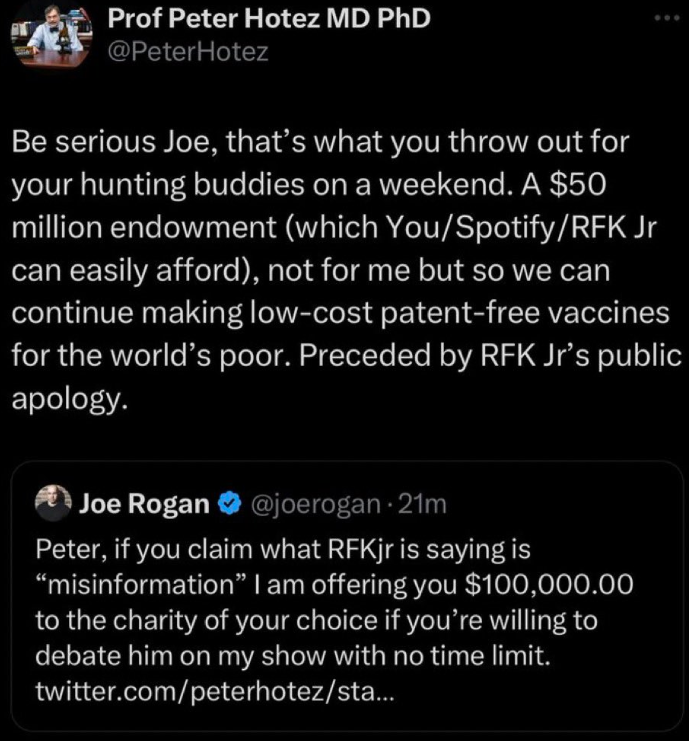
Hotez became a high-profile media figure during the COVID-19 era, appearing frequently on cable news to defend mandates, school closures, and censorship of dissenting scientists. He declined invitations to debate Robert F. Kennedy Jr on Joe Rogan’s podcast (despite public challenges from Rogan, Elon Musk, and others) and has faced protests and online criticism for his stance.
Hotez’s advocacy for compulsory vaccination and his characterization of skeptics as a monolithic “anti-science” movement directly conflicts with core libertarian principles. Bodily autonomy is a fundamental right; no expert—however credentialed—has the moral authority to authorize aggression against peaceful individuals who decline medical interventions. Mandates substitute the subjective risk assessments of bureaucrats and academics for the voluntary choices of parents and patients in a genuine marketplace of ideas and services.
His career is heavily intertwined with taxvictim-funded institutions (NIH, Baylor, international NGOs) and globalist frameworks that an anarcho-capitalist society would replace with private charity, competing certification agencies, and likely full legal liability for vaccine producers. The low-cost Corbevax project, while innovative, was executed through the very state and quasi-state channels that crowd out superior private solutions. Hotez’s refusal to engage critics in open debate further exemplifies the authoritarian impulse: rather than letting the best arguments win in a free marketplace, he prefers institutional power to marginalize opposition.
Hotez has received awards from establishment bodies (including the inaugural Anthony Fauci Courage in Leadership Award) and has been targeted by anti-mandate activists, including a 2023 incident outside his home. These clashes underscore the broader conflict between coercive public-health regimes and individual liberty.
Legacy#
Peter Hotez relevance here stems mainly from exemplifying how credentialed experts lend scientific legitimacy to the expansion of state control over personal health decisions. His tropical-disease research demonstrates the value of decentralized scientific inquiry when left relatively free; his public-health advocacy demonstrates the dangers when that inquiry is married to political power.
In a truly free society, medicine would operate under voluntary contracts, transparent pricing, consumer-driven standards, and strict liability—without mandates, without regulatory monopolies, and without the false dichotomy of “pro-science” versus “anti-science” used to silence dissent. Hotez’s career serves as a useful case study of the statist mindset that anarcho-capitalists seek to dismantle: the belief that experts backed by force can and should override individual sovereignty “for the greater good.”
Social Media Links: