
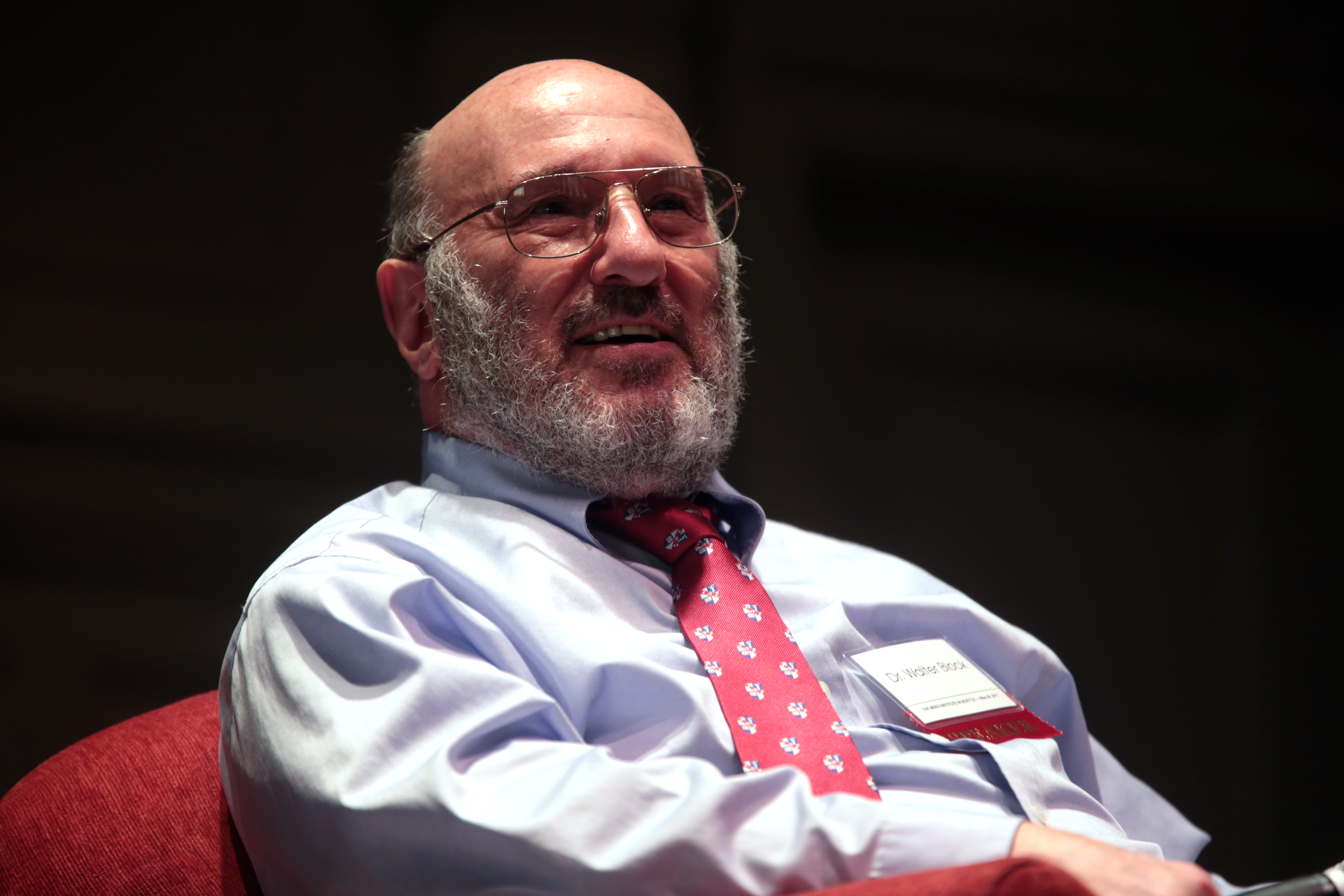
Walter Block (born August 21, 1941) is an American economist of the Austrian School and one of the most influential anarcho-capitalist theorists of the late 20th and early 21st centuries. A leading proponent of stateless free-market anarchism, Block is best known for his uncompromising application of the non-aggression principle (NAP) and private property rights to every sphere of human action. He has authored or co-authored over two dozen books and more than 600 peer-reviewed articles, consistently arguing that all government functions—from roads and courts to oceans, space, and even criminal justice—can and should be fully privatized.
As the Harold E. Wirth Eminent Scholar Endowed Chair in Economics at Loyola University New Orleans, Block has trained generations of libertarians while serving as a senior fellow (2000–2024) and later adjunct scholar at the Mises Institute. His work stands as a radical extension of the Rothbardian tradition, defending voluntary interactions that mainstream society condemns and exposing the state as the root of coercion and inefficiency.
Early Life and Intellectual Conversion#
Walter Edward Block was born in Brooklyn, New York, to Abraham Block, a certified public accountant, and Ruth Block, a paralegal—both described by Block as liberals. He attended James Madison High School alongside future socialist Bernie Sanders (who ran on the track team with him). Block initially embraced communism in his youth but underwent a profound ideological shift during his undergraduate years at Brooklyn College (B.A. in philosophy, 1964). A lecture by Ayn Rand, followed by reading Atlas Shrugged and Henry Hazlitt’s Economics in One Lesson, pulled him toward libertarianism. The decisive influence came from meeting Murray Rothbard, whom Block credits as his mentor, guide, and friend. He earned his Ph.D. in economics from Columbia University in 1972, with a dissertation on rent control supervised by Gary Becker and William Landes.
Block has long described himself as a “big fan” of Rand while rejecting Objectivism’s minimal-government stance as insufficiently consistent with anarcho-capitalist principles. He remains a devout atheist and holds dual U.S.-Canadian citizenship.
Academic Career#
Block has held teaching positions at the University of Central Arkansas, Holy Cross College, Baruch College (CUNY), and Rutgers University. Since the early 2000s he has occupied the Wirth Chair at Loyola University New Orleans’ College of Business. From 1979 to 1991 he served as senior economist at the Fraser Institute in Canada. His prolific output includes over 500 peer-reviewed articles by 2017 (now exceeding 600), thousands of op-eds, and frequent radio, television, and public appearances. Block is renowned for mentoring students; more than 100 of their term papers under his guidance have appeared in refereed journals.
Contributions to Anarcho-Capitalism#
Block’s scholarship is defined by its relentless application of Austrian economics and Rothbardian anarcho-capitalism to controversial and “undefendable” topics. He argues that the state is not a necessary evil but a criminal organization violating the NAP on a massive scale. True liberty, in his view, requires the complete privatization of society: roads, highways, oceans, rivers, lakes, aquifers, space travel, courts, police, and even the airwaves.
His most iconic work, Defending the Undefendable (1976), remains a cornerstone of anarcho-capitalist literature. In it, Block demonstrates that professions routinely vilified by the public—prostitutes, pimps, drug dealers, slumlords, ticket scalpers, and blackmailers—engage in purely voluntary, non-aggressive exchanges that benefit society under the free market. Endorsed by Rothbard and translated into more than a dozen languages, the book serves as a pedagogical tool for illustrating how the NAP reveals the moral superiority of laissez-faire capitalism over state intervention.
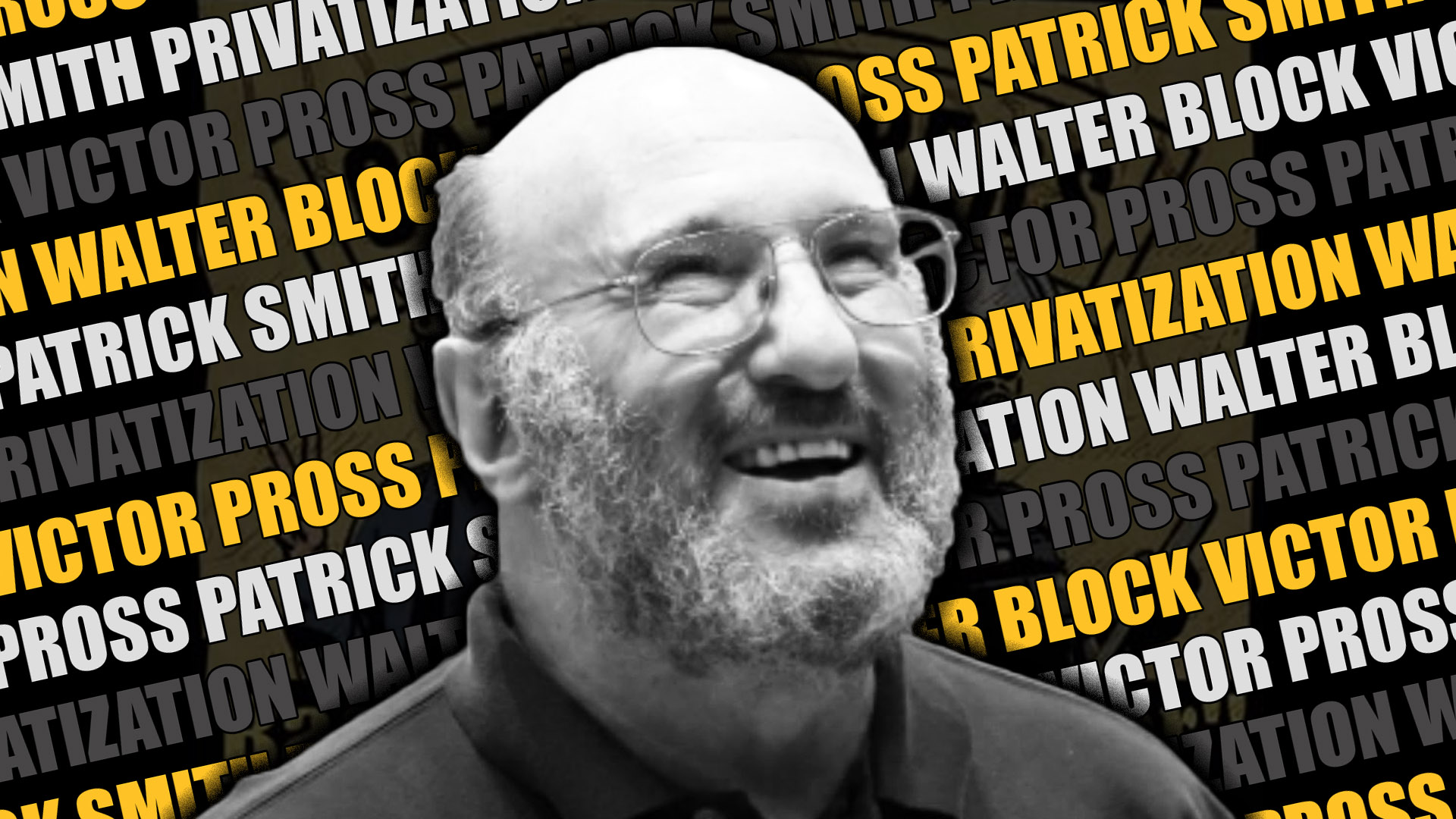
Patrick Smith was honored to provide the audiobook voice performance for Blocks’ Defending the Undefendable 2.
Defending the Undefendable 2
Block has extended these principles into new frontiers. In The Privatization of Roads and Highways (2009), he documents how government “road socialism” causes tens of thousands of deaths annually through inefficiency and lack of accountability; private ownership with profit-driven safety incentives would dramatically reduce fatalities. Water Capitalism (2016) and Space Capitalism (2018, with Peter Lothian Nelson) apply the same logic to natural resources and extraterrestrial colonization, arguing that private property titles, homesteading, and free exchange are the only rational basis for managing scarce resources.
Notable Ideas and Theories#
- Evictionism: Block’s distinctive libertarian position on abortion. A pregnant woman has the right to evict the fetus from her property (the womb) at any time, but not the right to actively kill it if it can survive outside the womb. This framework reconciles property rights with the NAP without granting the fetus positive rights to the mother’s body. (this position was challenged by Patrick Smith in an inteview with Block that it could only be justified in cases of rape)
- Blockean Proviso and homesteading: Refining Lockean theory, Block argues that if one’s property claim (e.g., a donut-shaped plot) prevents access to unowned land, an easement must exist to avoid monopoly power over territory.
- Voluntary slave contracts: In a fully libertarian society, competent adults may sell themselves into slavery via contract, consistent with self-ownership and the NAP.
- The Case for Discrimination (2010): Private individuals and businesses have an absolute right to discriminate on any basis—race, sex, religion, etc.—as an exercise of property rights. Block contends that anti-discrimination laws violate liberty and that market forces, not government coercion, best address irrational prejudice.
These positions exemplify Block’s method: take the most politically incorrect implications of anarcho-capitalist axioms and defend them without compromise.
Major Works#
Block’s bibliography is vast. Among the most prominent from an anarcho-capitalist perspective:
- Defending the Undefendable (1976) — his breakthrough classic.
- Defending the Undefendable II (2013) and subsequent volumes.
- The Privatization of Roads and Highways: Human and Economic Factors (2009).
- Building Blocks for Liberty: Critical Essays (2010).
- The Case for Discrimination (2010).
- Labor Economics from a Free Market Perspective: Employing the Unemployable (2008).
- Water Capitalism: The Case for Privatizing Oceans, Rivers, Lakes, and Aquifers (2016, with Peter Lothian Nelson).
- Space Capitalism: How Humans Will Colonize Planets, Moons, and Asteroids (2018).
- Yes to Ron Paul and Liberty (2012) and numerous collections on Austrian economics, religion, and law.
He has also edited influential volumes on zoning, rent control, discrimination, and environmental economics, always from a radical free-market standpoint.
Legacy in the Anarcho-Capitalist Movement#
Walter Block stands as a living bridge between the Rothbardian generation and contemporary anarcho-capitalism. His willingness to defend “politically incorrect” applications of liberty has inspired countless libertarians while inviting fierce criticism from statists and even some minarchists. Through his teaching, writing, and public advocacy, Block continues to demonstrate that anarcho-capitalism is not a utopian fantasy but a coherent, principled system capable of addressing every social question through voluntary cooperation and private property. His work remains essential reading for anyone serious about achieving a stateless society grounded in the non-aggression principle.
Disenthrall Content featuring Walter Block


Anarchast Content featuring Walter Block

Articles featuring Walter Block

I Was Wrong on Walter Block
Related People


Related Concepts
Related Organizations
